
-네요 is the go-to ending for compliments in Korean, but it can also sound sarcastic. A dragged-out tone, words like 참 or 잘도, and the wrong situation can turn 잘하시네요 (“You’re good at this”) into “Oh, great job” said with an eye roll.
Level: Intermediate · TOPIK 3-4
Learners love -네요 because it makes small talk easy. That is exactly why it is worth knowing how it can backfire. Here are the signals that make -네요 sarcastic, and how to make sure your compliments land the way you mean them.
Why -네요 Can Go Both Ways
-네요 is a reaction to something you just noticed. The ending itself is neutral. What the listener hears depends on what you noticed and how you say it.
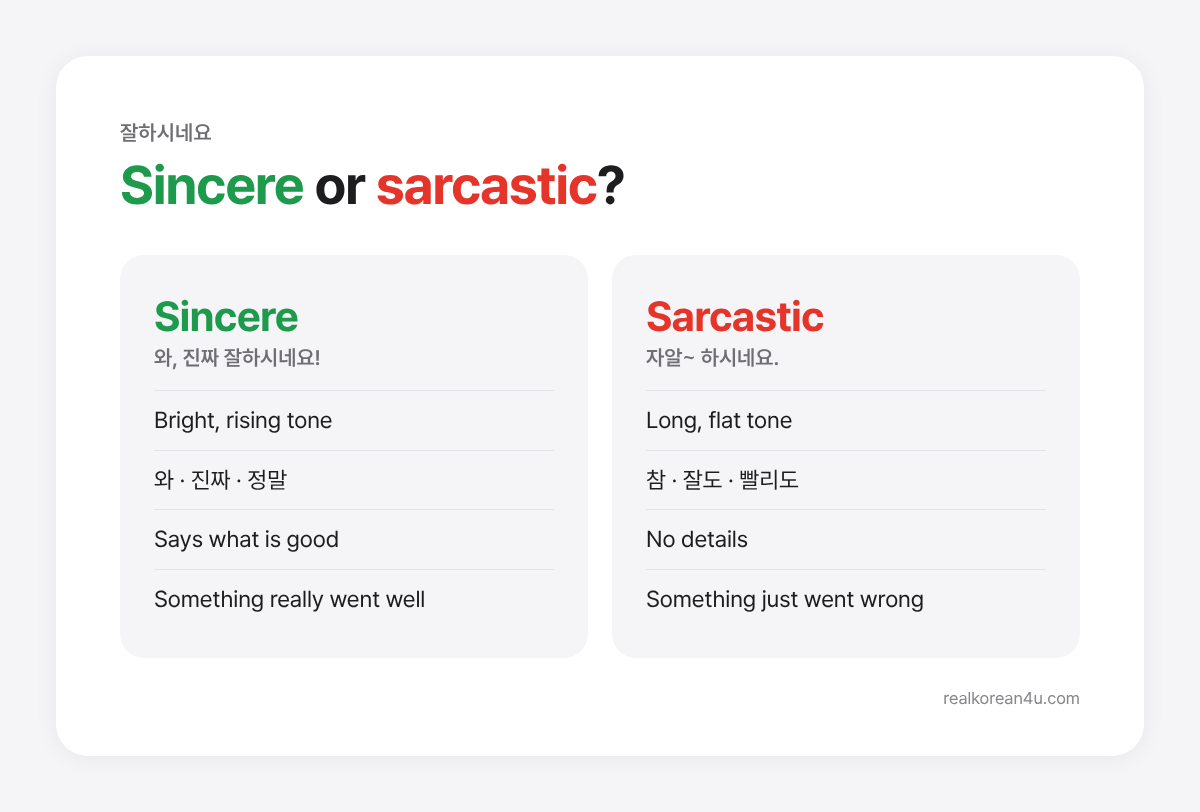
Wow, you’re really good at this! (Bright tone, after watching someone do well.)
Oh, great job. (Long, flat tone, after someone made a mistake.)
The words are almost the same. The situation and the tone do all the work.
Notice the -시- in 잘하시네요. Sarcasm that sounds like a real insult usually comes with this polite -시-: being extra polite while saying something negative makes it sting. Without it, as in 잘하네 between friends, sarcasm usually sounds like playful teasing.
Four Signals That Make -네요 Sarcastic
1. A long, flat tone
Stretching the first syllable, like 자알~ or 조옿~, and saying it slowly without a smile is the clearest sign. In writing, people show this with a tilde in the middle of the word: 잘~하시네요, 좋~겠네요.
2. Words like 참, 아주, 잘도, and -도
Some words push -네요 toward sarcasm, especially with something bad.
Wow, you got here so fast. (To someone who is an hour late.)
Well, you sure can eat. (Said about someone eating your snacks.)
Here, -도 after an adverb (빨리도, 일찍도) is a strong signal. It almost always means the opposite.
3. Praising something that went wrong
If the situation is clearly bad, a “compliment” can only be sarcastic.
Impressive. (Meaning: unbelievable.)
4. -겠네요 about someone else’s luck
좋겠네요 (“That must be nice”) can be sincere, but with a flat tone it sounds envious or bitter, like “Must be nice for some people.”
How to Make Sure You Sound Sincere
You don’t have to stop using -네요. Just give the listener enough clues that you mean it.
| Do this | Example |
|---|---|
| Add 와 or 진짜 at the start | 와, 진짜 잘하시네요! |
| Say what exactly is good | 발음이 정말 좋으시네요. |
| Add a second sentence | 사진 잘 나왔네요. 저도 보내 주세요! |
| Use a bright, rising tone | Smile and don’t drag the syllables |
For good news, 잘됐네요 (“That’s great”) or 축하해요 is safer than 좋겠네요, because they are clearly happy for the other person.
Three Short Conversations
1. A friend is late
A 미안, 많이 기다렸지?
(Sorry, did you wait long?)
B 아니, 왜 이렇게 일찍 왔어?
(Wow, why are you so early?)
B is joking. Here 아니 doesn’t mean “no.” It’s just a filler that adds feeling, like “Wow” or “Come on.” B could also say 일찍도 왔네 on its own. Between close friends, this kind of sarcasm is playful. With a coworker, it would sound like a real complaint.
2. Good news from a coworker
A 저 이번에 승진했어요.
(I got promoted.)
B 와, 잘됐네요! 축하드려요.
(Wow, that’s great! Congratulations.)
If B had said only 좋겠네요 in a flat voice, A might wonder if B is jealous.
3. Complimenting a learner
A 저 한국어 배운 지 6개월 됐어요.
(I’ve been learning Korean for six months.)
B 진짜요? 벌써 이렇게 잘하시네요!
(Really? You’re already this good!)
진짜요? and 벌써 make the praise sound warm and surprised, not sarcastic.
Common Mistakes
1. Replying to good news with only 좋겠네요
On its own and said flatly, it can sound envious. Add 와 and a congratulation, or use 잘됐네요.
2. Adding a tilde when judging someone above you
A tilde at the end of a sentence is not sarcastic by itself. Many people in their 40s and older use it to sound friendly, and younger people may just find it a little old-fashioned. The problem is a tilde at the end of a comment that judges someone above you, like their work. Then it sounds cheeky, as if you are rating your boss. Use ! instead.
(To your manager) 발표 잘하시네요~
발표 정말 잘하시네요!
Your presentation was really great!
3. Forgetting that -군요 and -구나 can be cold too
Sarcasm isn’t only a -네요 thing. In an argument, a slow, flat 아, 그러셨군요 can sound like “Oh, is that so” with no interest at all. A drawn-out 그랬구나~ can feel dismissive, as if the speaker isn’t taking you seriously. In calm conversation, both are perfectly kind. In a tense moment, tone decides everything.
🗣️ Try It Today
Pick one and use it with a Korean friend today.
잘됐네요!
That’s great! (Good news.)고생 많으셨네요.
You must have worked so hard.덕분에 살았네요.
You saved me. Thanks to you.와, 많이 늘었네요!
Wow, you’ve improved a lot!사진 진짜 잘 나왔네요!
The photo came out really well!
Quick Quiz
✏️ Sincere or sarcastic?
- (Your friend arrives two hours late) 일찍도 왔네.
- (Your coworker passed a hard exam) 와, 진짜 잘됐네요!
- (Said slowly, after someone broke a cup) 자알~ 하시네요.
- Your friend got a new job. Which is safer? (좋겠네요 / 잘됐네요!)
👉 Show answers
- Sarcastic. 일찍도 after a long wait means the opposite.
- Sincere. 와 and 진짜 make it clearly warm.
- Sarcastic. A dragged tone after a mistake.
- 잘됐네요! It is clearly happy for them. 좋겠네요 can sound envious.
Summary
-네요 itself is neutral. A long, flat tone, words like 참 and 잘도, -도 after an adverb, and “praise” for something that went wrong make it sarcastic. To sound sincere, add 와 or 진짜, say what is good, and use 잘됐네요 for good news.
📘 Start with the basics -네요 vs -군요 vs -구나: How Koreans Say “Oh, I See!” Learn the difference between the three “realization” endings first. Read the basics →