
-네요, -군요, and -구나 all express “Oh, I see!” -네요 reacts to something you notice right now and shares the feeling with the listener. -군요 marks a new fact you just learned, and -구나 is its casual version, also used when talking to yourself.
Level: Intermediate · TOPIK 3-4
Textbooks often translate all three as “Oh!” or “Wow!”, so they look interchangeable. In real conversation, Koreans choose between them without thinking, and the wrong one can sound stiff or oddly casual. This post shows the difference with everyday situations.
The Short Answer: -네요 vs -군요 vs -구나
-네요: “Oh, look!” A reaction to what you see, hear, or feel right now. Invites the listener to share it.
-군요: “Ah, so that’s how it is.” A new fact clicks into place. Polite and a bit formal.
-구나: The casual -군요. Used with friends, younger people, or to yourself.
Here is the same situation with each ending. You look out the window and see snow.
Wow, it’s snowing! (The most common choice. Works in person, by text, or on the phone.)
Ah, it’s snowing. (Same job as 오네요, just a slightly more formal tone.)
Oh, it’s snowing. (Casual. In a flat tone, it can sound uninterested.)
Wow, it’s snowing!! (With a surprised, happy tone, it sounds excited.)
How to Form Them
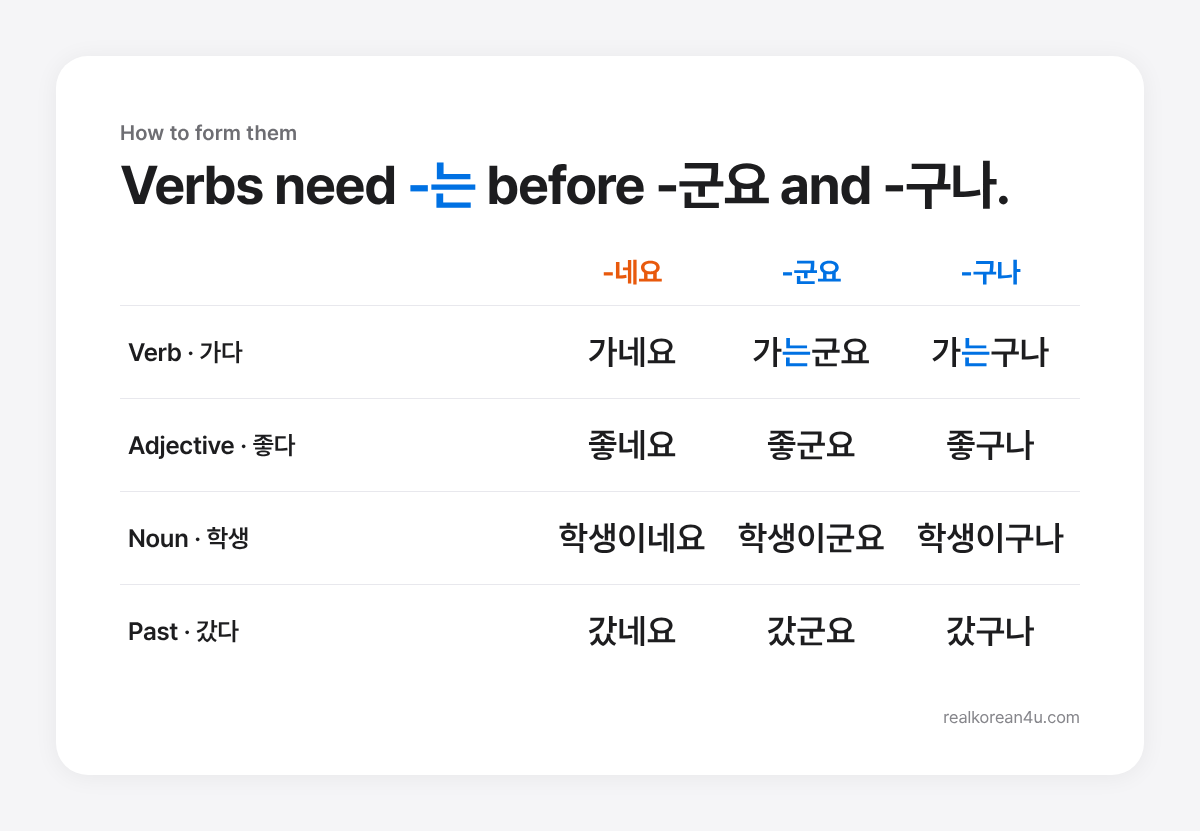
| -네요 | -군요 | -구나 | |
|---|---|---|---|
| Verb (가다) | 가네요 | 가는군요 | 가는구나 |
| Adjective (좋다) | 좋네요 | 좋군요 | 좋구나 |
| Noun (학생) | 학생이네요 | 학생이군요 | 학생이구나 |
| Past (갔다) | 갔네요 | 갔군요 | 갔구나 |
The tricky part is that verbs in the present tense take -는 before -군요 and -구나: 가는군요, 먹는구나. Adjectives don’t: 좋군요, 춥구나. -네요 is simpler because it attaches the same way to both.
Verb stems ending in ㄹ drop the ㄹ before -네요 and -는: 살다 becomes 사네요 and 사는군요.
-네요: “Oh, Look at This!”
Use -네요 when you react to something you are experiencing right now: something you see, taste, hear, or feel. It also invites the listener to agree, so it is perfect for small talk.
The food is really good. (While eating.)
Oh, look how late it’s gotten.
You speak Korean well. (After hearing someone speak.)
Because -네요 is a fresh reaction, it sounds strange about plain facts you already know, like 저는 키가 크네요 about yourself. To say you just realized something about yourself, Koreans use -(으)ㄴ 편이네요 (“I guess I’m on the … side”): 제가 키가 큰 편이었네요. (“Oh, I guess I’m actually on the tall side.”)
-군요: “Ah, So That’s How It Is”
Use -군요 when a new fact clicks into place, very often after someone tells you something. It does the same job as -네요 in many situations, but it sounds a little more formal.
A 저 다음 달에 결혼해요.
(I’m getting married next month.)
B 아, 그렇군요! 축하드려요.
(Oh, I see! Congratulations.)
So this neighborhood is busy even at night.
In everyday speech, the most common -군요 by far is 그렇군요 (“I see”). Many people use it as a polite way to show they are listening.
-구나: The Casual Version, and Talking to Yourself
-구나 means the same as -군요, but in casual speech. Use it with friends and people younger than you. Koreans also use it when they talk to themselves, which -군요 rarely does.
Oh, so that’s why you were late. (To a friend.)
It’s already fall. (Thinking out loud.)
Never use -구나 with someone older or higher than you. It is casual speech, so it sounds like talking down.
Bonus: -겠네요 for Guessing How Someone Feels
When someone tells you about their situation, Koreans often react with -겠네요. It means “That must be…” and shows you are imagining how they feel. It is one of the most useful listening phrases in Korean.
A 어제 세 시간밖에 못 잤어요.
(I only slept three hours last night.)
B 아이고, 많이 피곤하시겠네요.
(Oh no, you must be really tired.)
That must be nice! (Good news, said with a bright tone.)
That must be hard.
Compare it with 그렇군요. 그렇군요 says “I understand the fact.” -겠네요 says “I can imagine how you feel,” so it usually sounds warmer. Like -네요, though, it depends on tone. Said flatly, 좋으시겠네요 can sound sarcastic.
Side-by-Side Comparison
| -네요 | -군요 | -구나 | |
|---|---|---|---|
| Feeling | Fresh reaction | New fact clicks | New fact clicks |
| Speech level | Polite | Polite, a bit formal | Casual |
| Talks to | The listener | The listener | A friend, or yourself |
| Typical use | Small talk, compliments | 그렇군요, a more formal tone | Self-talk, friends |
One more thing: -네요 is so common in compliments that tone matters a lot. The same 잘하시네요 can be warm praise or a sharp comment, especially with the polite -시-.
🗣️ Native insight Why can 잘하시네요 sound like an insult? The words, tone, and situations that turn -네요 sarcastic. Read the answer →Common Mistakes
| ❌ Wrong | ✅ Right | Why |
|---|---|---|
| 아, 지금 가군요. | 아, 지금 가는군요. Oh, so you’re leaving now. | Present-tense verbs need -는 before -군요. |
| (To your teacher) 아, 그렇구나. | 아, 그렇군요. Oh, I see. | -구나 is casual. Use -군요 with people above you. |
| (About yourself) 저는 키가 크네요. | 제가 키가 큰 편이었네요. I guess I’m on the tall side. | For something you just realized about yourself, use -(으)ㄴ 편이네요. |
🗣️ Try It Today
Pick one and use it with a Korean friend today.
오늘 날씨 진짜 좋네요!
The weather is so nice today!벌써 금요일이네요.
It’s already Friday.잘 어울리네요!
It looks great on you!아, 그렇군요.
Ah, I see.그랬구나.
Oh, so that’s what happened. (To a friend.)
Summary and Quick Quiz
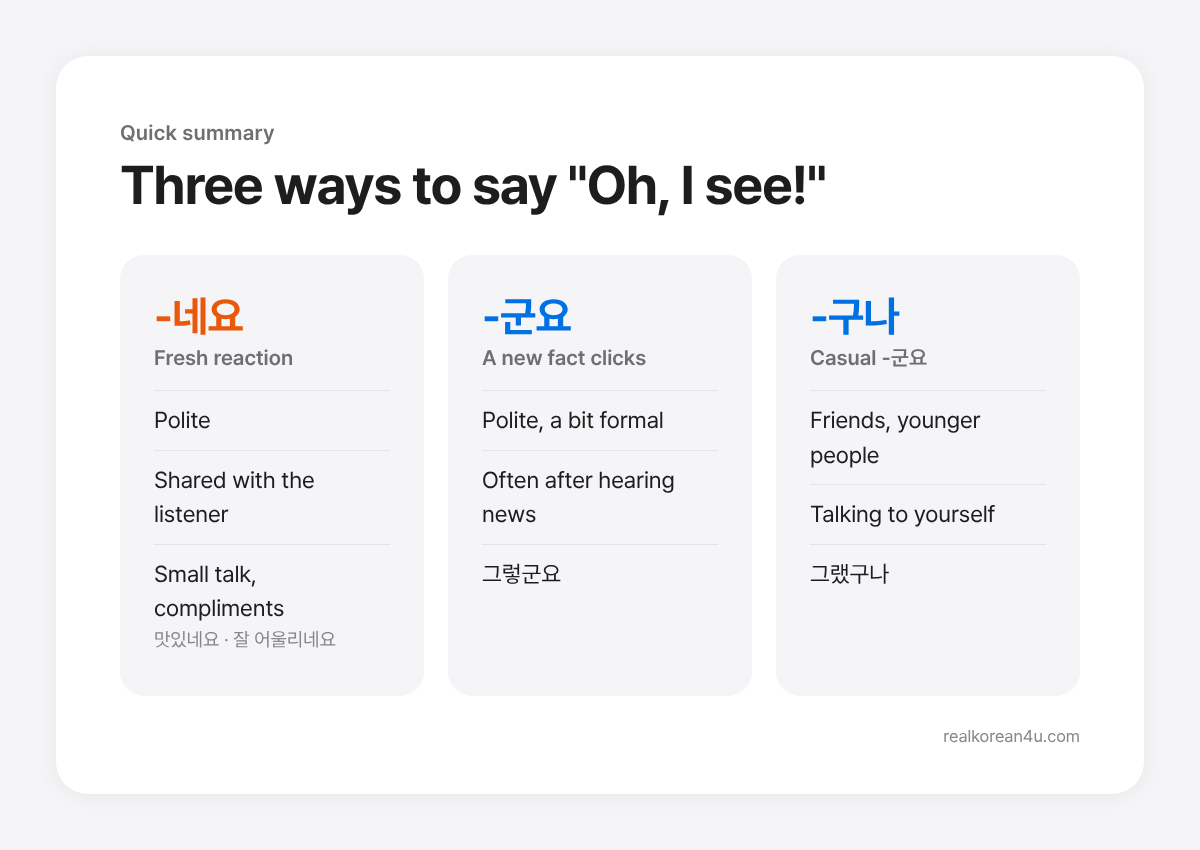
Use -네요 for fresh reactions you share with the listener, -군요 when a new fact clicks into place in polite speech, and -구나 for the same thing in casual speech or when talking to yourself.
✏️ Quick Quiz
Choose the most natural ending. Try it before you check the answers.
- (Tasting soup at a coworker’s house) 국이 정말 (맛있네요 / 맛있구나).
- (Your boss explains the new schedule) 아, (그렇군요 / 그렇구나).
- (Alone, looking at the calendar) 벌써 12월이(네요 / 구나).
- 아, 영화가 벌써 (시작하군요 / 시작하는군요).
👉 Show answers
- 맛있네요. A fresh, polite reaction while eating.
- 그렇군요. Polite. 그렇구나 would sound too casual to your boss.
- 구나. Talking to yourself.
- 시작하는군요. Present-tense verbs need -는.
📗 Next: Learn when -네요 turns sarcastic, and how to make your compliments sound sincere. When -네요 Sounds Sarcastic (and How to Sound Sincere)