
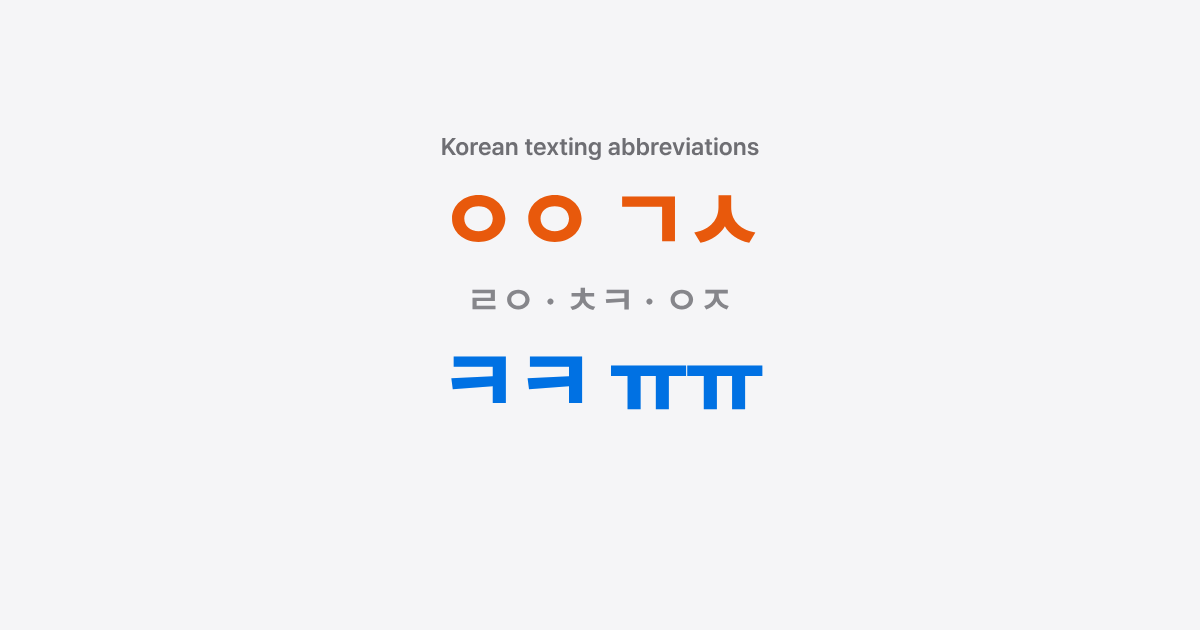
Most Korean texting abbreviations keep only the first consonant of each syllable: 감사 (thanks) becomes ㄱㅅ, and 축하 (congrats) becomes ㅊㅋ. Here are 20 that Koreans use every day, what they mean, and who you can send them to.
Level: Beginner · TOPIK 1-2
Open any Korean group chat and you will see strings like ㅇㅇ, ㄹㅇ, and ㅠㅠ. They look like code, but most of them follow one simple pattern. Once you know it, you can read many abbreviations you have never seen before.
The Short Answer: How Korean Texting Abbreviations Work
Rule: Take the first consonant of each syllable and drop everything else.
Use them with: friends and people your age in casual chats. Not with teachers, bosses, or people you just met.
Here is the pattern with one word.
| Syllable | First consonant |
|---|---|
| 감 (gam) | ㄱ |
| 사 (sa) | ㅅ |
| 감사 (thanks) | ㄱㅅ |
Koreans call these first consonants 초성 (choseong). That is why you will sometimes see people write “초성으로” (in initials) when they type this way.
12 Consonant Abbreviations
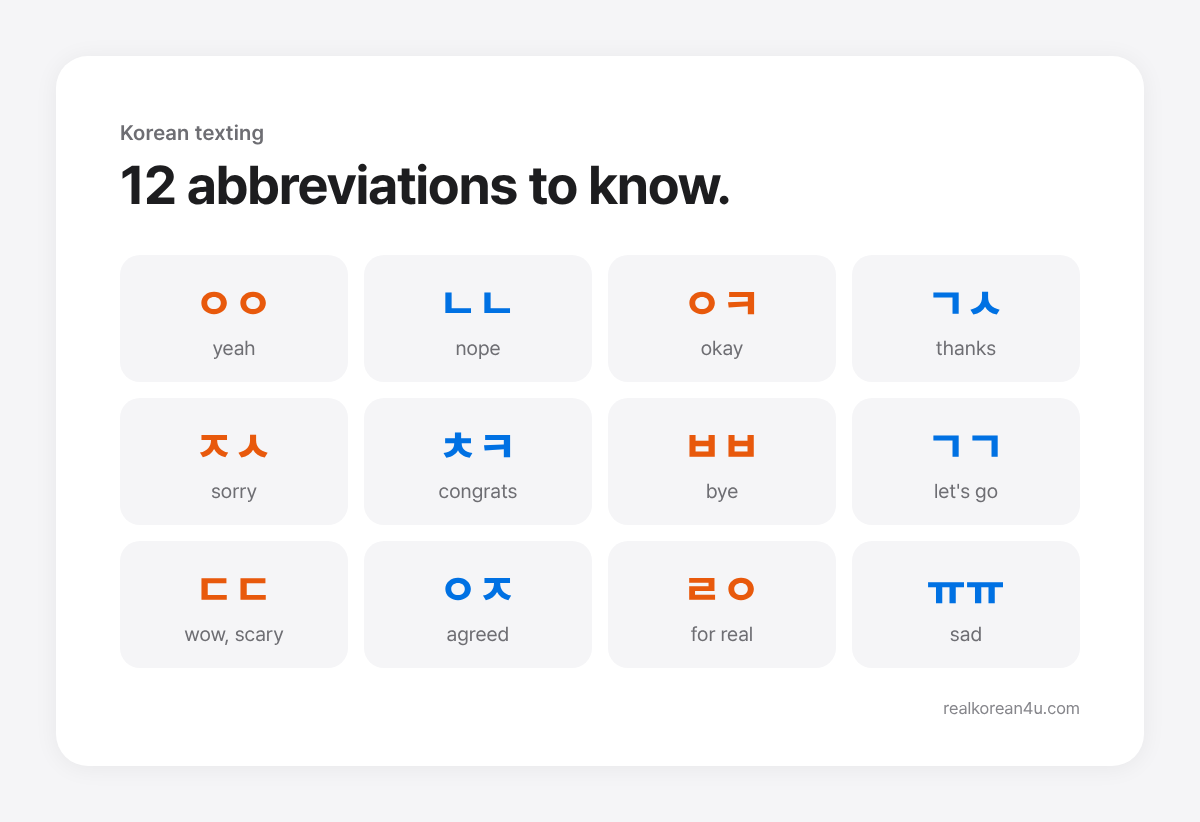
| Abbreviation | From | Meaning |
|---|---|---|
| ㅇㅇ | 응응 | yeah, OK |
| ㄴㄴ | 노노 | no, nope |
| ㅇㅋ | 오케이 | okay |
| ㄱㅅ | 감사 | thanks |
| ㅈㅅ | 죄송 | sorry |
| ㅊㅋ | 축하 | congrats |
| ㅂㅂ | 바이바이 | bye |
| ㄱㄱ | 고고 | let’s go |
| ㄷㄷ | 덜덜 | wow, scary (the sound of trembling) |
| ㅇㅈ | 인정 | agreed, true |
| ㄹㅇ | 리얼 | for real |
| ㅠㅠ / ㅜㅜ | (crying eyes) | sad, touched, or “please” |
Notice that some of these come from English words: 오케이 (okay), 노노 (no no), 바이바이 (bye-bye), 고고 (go go), 리얼 (real). ㅠㅠ is different. It is not a word at all, but a picture of two crying eyes.
Here is how they look in real messages.
okei gamsa!
OK, thanks!
siheom hapgyeokaesseo? daebak chukachuka
You passed the exam? Wow, congrats!
geu yeonghwa rieol museoum deoldeol
That movie is seriously scary.
Repeating an abbreviation, like ㅊㅋㅊㅋ, makes it sound more cheerful. You will also see ㅋㅋ and ㅎㅎ everywhere. They are both laughter, but they don’t feel the same.
🗣️ Native insight Why does a single ㅋ sound like teasing, when ㅋㅋㅋ sounds friendly? ㅋㅋ vs ㅎㅎ, ^^, and what your laugh says about you. Read the answer →4 Shortened Words
Some common words are simply cut short in texts. These are full syllables, not just consonants.
neom → neomu
넘 피곤해 = I’m so tired.
gyang → geunyang
걍 집에 있을래 = I’ll just stay home.
nael → naeil
낼 봐 = See you tomorrow.
ssaem → seonsaengnim
Many students call their teachers 쌤, especially friendly, outgoing teachers. With a strict teacher, they stick to 선생님.
4 Chat Culture Words
These words describe how people use KakaoTalk, the messaging app almost every Korean uses.
| Word | From | Meaning |
|---|---|---|
| 단톡 | 단체 톡방 | group chat |
| 프사 | 프로필 사진 | profile picture |
| 읽씹 | 읽고 씹다 | to read a message and ignore it (“left on read”) |
| 꿀잼 / 노잼 | 꿀 + 재미 / no + 재미 | super fun / boring |
wae ikssipae?
Why are you leaving me on read?
There is also 안읽씹 (anikssip): not even opening the message. In KakaoTalk, a little “1” next to your message means the other person hasn’t read it yet. Which one hurts more, 읽씹 or 안읽씹, depends on the person.
Slang gets old fast: 늙크크 and 영크크
Texting slang changes quickly, and Koreans notice who keeps up. A recent buzzword is 영크크 (yeongkeukeu), from “Young Creator Crew,” the title of a song by the boy group CORTIS. People use it for young, trendy people who are up to date. Its joking opposite is 늙크크 (neukkeukeu), made by combining 늙다 (to be old) with 영크크. It describes someone whose slang or style feels a little dated.
For example, 헐 대박 (“Whoa, amazing”) is still understood by everyone, but teenagers may hear it as a little 늙크크. Many of them say 엥 (eng, “huh?”) or 엥 ㄹㅇ? (“huh, for real?”) instead. Be careful with 엥, though. It is fine between friends, but it can sound too casual to someone in their twenties or older you don’t know well, and rude to anyone older than you.
Do Koreans Say These Out Loud?
Most consonant abbreviations stay in texts. Nobody says “ㄱㅅ” out loud. But the words behind some of them are common in speech, especially among younger people.
i norae jinjja jota. injeong!
A: This song is so good. B: True!
geu yeonghwa wanjeon kkuljaemiya.
That movie is so much fun.
dantokbangeseo yaegihaja.
Let’s talk about it in the group chat.
So when you learn an abbreviation, learn the word behind it too. You will be able to read it in chats and recognize it in conversation.
When Not to Use Them
Texting abbreviations are casual. Sending them to someone older or higher than you can feel lazy or disrespectful, even if your message is kind.
(To your teacher) ㄱㅅ!
감사합니다!
gamsahamnida!
Thank you!
(To your boss) ㅇㅋ
네, 알겠습니다.
ne, algetseumnida.
Yes, understood.
Also avoid them in your first message to someone new. Wait until the other person starts using them with you. Once they do, it is usually a sign that the chat has become relaxed.
Common Mistakes
| ❌ Wrong | ✅ Right | Why |
|---|---|---|
| (To an older coworker) ㅇㅇ | 네! ne! Yes! |
ㅇㅇ is casual. It can sound like you don’t care. |
| (In a sorry message to a friend) ㅈㅅ | 미안해 ㅠㅠ mianhae I’m sorry. |
For a real apology, ㅈㅅ can feel too quick. Write it out. |
| Writing a whole message in initials | Mix: ㅇㅋ 낼 7시에 봐 | All-initial messages are hard to read, even for Koreans. |
🗣️ Try It Today
Pick one and use it with a Korean friend today.
ㅇㅋ 낼 봐!
okei nael bwa!
OK, see you tomorrow!생일 ㅊㅋㅊㅋ!
saengil chukachuka!
Happy birthday!단톡에 올려 줘!
dantoge ollyeo jwo!
Post it in the group chat!엥 ㄹㅇ?
eng rieol?
Huh, for real? (Friends only.)프사 바꿨네?
peusa bakkwonne?
You changed your profile picture?
Summary and Quick Quiz
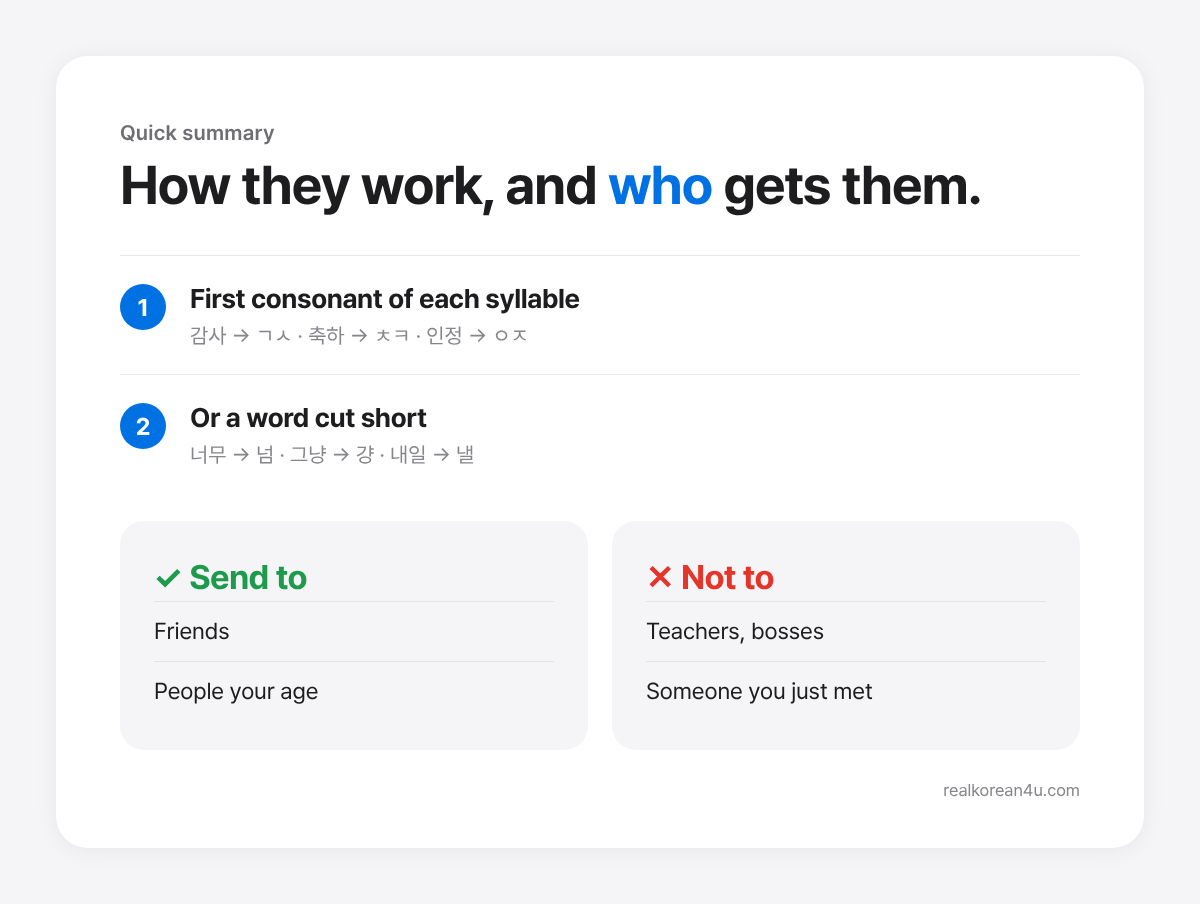
| Type | Examples | How it works |
|---|---|---|
| Consonant abbreviations | ㅇㅇ, ㄱㅅ, ㅊㅋ, ㄹㅇ | First consonant of each syllable |
| Shortened words | 넘, 걍, 낼, 쌤 | A word cut short |
| Chat culture words | 단톡, 프사, 읽씹 | Two words squeezed into one |
| Who to send them to | Friends, people your age | Not teachers, bosses, or new contacts |
✏️ Quick Quiz
What do these messages mean? Try it before you check the answers.
- ㅇㅈ
- 낼 ㄱㄱ?
- 왜 읽씹함? ㅠㅠ
- Your teacher sends you good news. Is “ㅊㅋ” a good reply?
👉 Show answers
- Agreed / true. From 인정.
- “Shall we go tomorrow?” 낼 = 내일, ㄱㄱ = 고고.
- “Why are you leaving me on read?” With a sad face.
- No. Write it out politely: 축하드려요!
📗 Next: Find out what ㅋ, ㅋㅋ, ㅎㅎ, and ^^ really say about you. ㅋㅋ vs ㅎㅎ: What Your Korean Laugh Really Says in Texts