
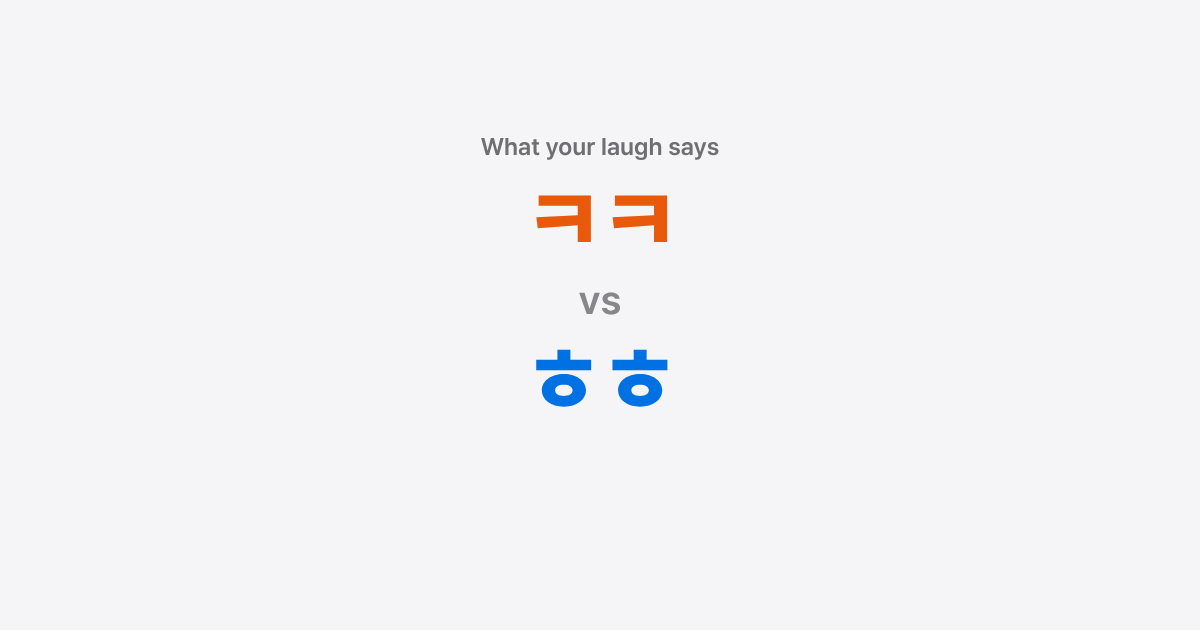
ㅋㅋ and ㅎㅎ both mean laughter in Korean texts, but they don’t feel the same. ㅋㅋㅋ is a real laugh, one or two ㅎ is a friendly smile, and a single ㅋ can sound like teasing. The number of letters changes the meaning.
Level: Beginner · TOPIK 1-2
If you text with Koreans, you will see ㅋㅋ and ㅎㅎ in almost every chat. Choosing the wrong one won’t break a sentence, but it can change how friendly, polite, or sarcastic you sound. Here is what each one says.
Where ㅋㅋ and ㅎㅎ Come From
Both are short for laughing sounds.
| Text | Sound | Feeling |
|---|---|---|
| ㅋㅋ | 크크, 키득키득 (snickering) | Actually laughing. Like “lol” |
| ㅎㅎ | 흐흐, 히히 (soft chuckle) | Smiling. Like “hehe” or 🙂 |
So the simplest rule is this: ㅋㅋ when something is funny, ㅎㅎ when you want to sound warm.
Typing tip
On a Korean computer keyboard, ㅋ is on the Z key and ㅎ is on the G key. On a phone, add the Korean keyboard in your settings, and both letters appear on the main screen. They are fast to type, even with one thumb.
How Many ㅋ? Why the Number Matters
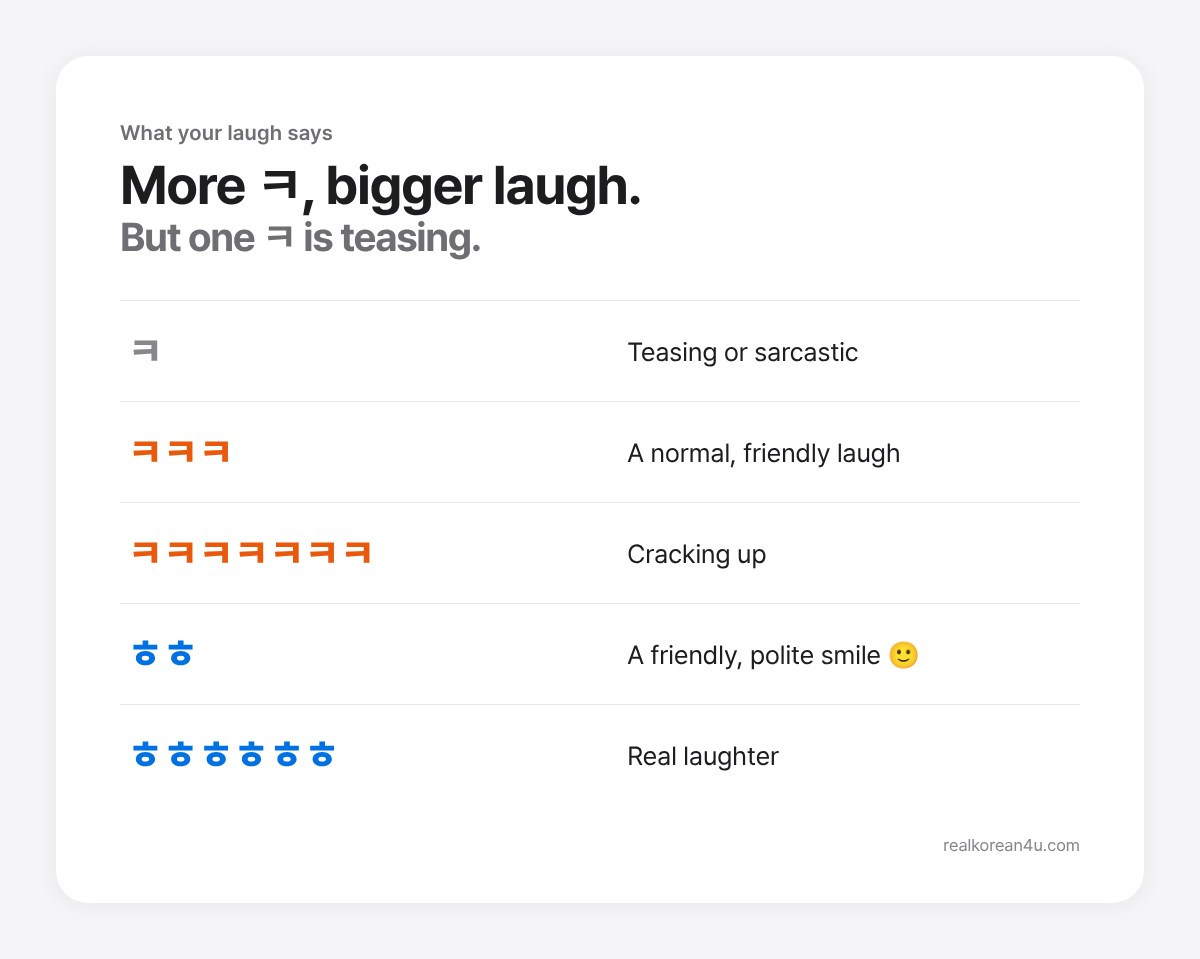
With ㅋ, more letters means a bigger laugh. But fewer is not just a smaller laugh. One ㅋ on its own has its own feeling.
| You type | It feels like |
|---|---|
| ㅋ | “Heh.” Dry, teasing, or sarcastic. Between close friends, often just playful |
| ㅋㅋㅋ | A normal, friendly laugh. The everyday default |
| ㅋㅋㅋㅋㅋㅋㅋ (or a whole line) | I’m cracking up |
keukeukeu jinjja utgida
LOL, that’s so funny.
jalhanda keu
Heh, nice going. (Teasing a close friend who just made a mistake.)
A single ㅋ is something close friends do to tease each other. It isn’t meant seriously. With someone you don’t know well, though, it can sound like you are mocking them. If you are unsure, use ㅋㅋㅋ.
An easy way to remember it: a single ㅋ is like a lone “lol,” and an endless line of ㅋㅋㅋㅋㅋㅋㅋㅋㅋㅋㅋㅋ is like “LMAO.”
When ㅎㅎ Works Better
One or two ㅎ make a plain message feel friendly and polite. People use it with coworkers and seniors they have gotten to know, when ㅋㅋㅋ might feel too casual. With people they aren’t close to yet, most Koreans skip both ㅋ and ㅎ and just write a plain, polite message.
ne, naeil bwaeyo heuheu
Sure, see you tomorrow 🙂
gamsahamnida heuheu
Thank you! 🙂
Like ㅋ, ㅎ gets bigger as it gets longer. ㅎㅎㅎㅎㅎㅎ feels like real laughter, not just a smile.
Other Laughs You’ll See
| Text | Meaning |
|---|---|
| ㅋㄷㅋㄷ | Giggling quietly (from 키득키득) |
| 하하 | A written-out laugh. Short and simple |
| 하핳ㅎ하하핳하 | Typos on purpose = cracking up. There’s no rule, just mash the keys. |
| ㅋㅋㅋㅎㅋㅋㅎㅎ | A mix of ㅋ and ㅎ, also a big laugh. No rule here either |
| 허허 | An awkward, embarrassed laugh (ㅎㅎ can do this too) |
| ^^ | Smiling eyes. Polite with older people, but see the note below |
A note on ^^
^^ works well as a polite smile when you text someone older. Among teenagers and people in their twenties, though, ^^ is often used sarcastically. So when an older person sends ^^ to a younger person, it can sometimes be read as sarcasm by mistake. And in an argument, ^^ always means sarcasm.
ne algetseumnida
Yes, understood ^^ (Polite to a teacher. In the middle of a fight, it means “Fine, whatever.”)
Use ^^ as a smile emoji with older people, and avoid it when things are tense.
Same Message, Different Laugh
Here is one reply to a friend who says they missed the bus again. Only the laugh changes.
tto? keu
Again? Heh. (Teasing.)
tto? keukeukeu
Again? Haha. (Friendly.)
tto? keukeukeu
Again?! LOL. (You find it really funny.)
tto? heuheu
Again? 🙂 (Gentle, maybe a little awkward.)
With one or two letters, Koreans read the situation carefully before sending. Longer laughs are easier to get right.
Common Mistakes
1. Laughing when nothing is funny
Some learners add ㅋㅋ to every message. When nothing funny was said, it can feel like “Why are you laughing?” This matters most with 넵, a friendlier 네 that people send to teachers or seniors they are close to. 넵 ㅋㅋ can look too casual. 넵 ㅎㅎ is safer.
2. Using ㅋㅋ in serious messages
Adding ㅋㅋ to an apology makes it sound like you are not taking it seriously.
늦어서 미안 ㅋㅋ
늦어서 미안해 ㅠㅠ
neujeoseo mianhae
Sorry I’m late.
3. Thinking close friends always use them
Very close friends often don’t bother with ㅋㅋ or ㅎㅎ. They don’t need to show they are friendly, so they just write short, plain messages, often ending in -음 or -슴, like 나 지금 감 (I’m going now).
🗣️ Try It Today
Pick one and use it with a Korean friend today.
ㅋㅋㅋㅋㅋ 미쳤다
keukeukeu michyeotda
LOL, that’s insane. (Also ㅋㅋㅋㅋ 미친 or ㅋㅋㅋㅋ ㅁㅊ. Close friends only.)넵 ㅎㅎ
nep heuheu
Yep! 🙂 (To a teacher or senior you are close to.)좋은 하루 보내세요 ㅎㅎ
joeun haru bonaeseyo heuheu
Have a nice day 🙂다음에 또 봐요 ㅎㅎ
daeume tto bwayo heuheu
See you next time 🙂ㅋㅋㅋ 나도 그 생각 했는데
keukeukeu nado geu saenggak haenneunde
Haha, I was thinking the same thing.
Quick Quiz
✏️ Which laugh fits best?
- Your best friend sends a hilarious video. (ㅎㅎ / ㅋㅋㅋㅋㅋㅋㅋㅋ)
- A senior you have gotten close to says “Good job today!” You reply 감사합니다 (ㅋ / ㅎㅎ)
- You want to tease your best friend, who tripped in front of everyone. (ㅋ / ^^)
- You are apologizing for missing a friend’s party. (ㅋㅋ / ㅠㅠ)
👉 Show answers
- ㅋㅋㅋㅋㅋㅋㅋㅋ. It’s really funny, so laugh big.
- ㅎㅎ. A friendly, polite smile. A single ㅋ could sound like teasing. (With someone you just met, you would skip both.)
- ㅋ. Playful teasing between close friends. ^^ would sound sarcastic.
- ㅠㅠ. Laughter makes an apology sound unserious.
Summary
ㅋㅋㅋ is the everyday laugh, and a long line of ㅋ means you are cracking up. A single ㅋ is teasing, which is fine with close friends but risky with others. One or two ㅎ add a friendly, polite smile. ^^ is polite with older people but sarcastic in a fight. Only laugh when something is funny, and keep laughter out of apologies.
📘 Start with the basics 20 Korean Texting Abbreviations: ㅇㅇ, ㄱㅅ, ㄹㅇ and More Learn the one pattern behind most Korean texting abbreviations. Read the basics →