
은/는 marks the topic, the thing you are talking about. 이/가 marks the subject, and it points at exactly who or what. Textbooks stop there, which is why the two still feel the same. Four simple rules decide most sentences for you.
Level: Beginner · TOPIK 1-2
Both particles come right after a noun, and both often translate to nothing at all in English. That makes them hard to tell apart. This post shows when each one is the natural choice, with examples you can copy.
The Short Answer: 은/는 vs 이/가
은/는 sets the topic: “As for me…” or “Talking about this…”. The important part comes after it.
이/가 picks out the subject: “I am the one.” The important part is the noun itself.
Here is the same sentence with each particle.
jeoneun haksaengieyo.
I’m a student. (Introducing yourself.)
jega haksaengieyo.
I’m the student. (Someone asked which one of you is the student.)
The words are almost the same, but the questions they answer are different. 저는 학생이에요 answers “Tell me about yourself.” 제가 학생이에요 answers “Who is the student?”
| Part | Meaning |
|---|---|
| 저 | I (polite) |
| 는 | topic marker (“as for”) |
| 학생 | student |
| 이에요 | am / is (polite) |
How to Attach Them
Each particle has two forms. Pick one by looking at the last letter of the noun.
| Noun ends in | Topic | Subject | Example |
|---|---|---|---|
| a consonant | 은 | 이 | 책은 / 책이 (book) |
| a vowel | 는 | 가 | 친구는 / 친구가 (friend) |
A few common words change shape before 가. Learn these four as single words.
- 저 + 가 → 제가 (I, polite)
- 나 + 가 → 내가 (I, casual)
- 너 + 가 → 네가 (you, casual). In everyday speech, most people say 너가 instead. Use 너가 only with someone your age or younger. You may also hear 니가, but that is only for very close friends or younger siblings (couples sometimes use it playfully, or in an argument). Anywhere else, 니가 sounds rude.
- 누구 + 가 → 누가 (who)
With 은/는 nothing changes: 저는, 나는, 너는.
Four Rules That Decide for You
![Four rules for choosing 은/는 or 이/가 in Korean]](https://realkorean4u.com/wp-content/uploads/2026/10/post02A_02_four-rules.png)
Instead of thinking “topic or subject?”, ask these four questions. They cover most everyday sentences.
Rule 1: Introducing yourself or a topic uses 은/는
When you start talking about something and then describe it, use 은/는. This is why self-introductions start with 저는.
저는 캐나다 사람이에요.
jeoneun kaenada saramieyo.
I’m Canadian.
제 고향은 토론토예요.
je gohyangeun torontoyeyo.
My hometown is Toronto.
Native tip: introducing yourself politely
In real conversation, Koreans often drop 저는 and just say their name. When they do, they usually switch to the more formal -입니다 to stay polite. When you meet someone for the first time in a formal setting, -입니다 is the most polite choice.
처음 뵙겠습니다. 에밀리입니다.
cheoeum boepkkesseumnida. emilli-imnida.
Nice to meet you. I’m Emily.
저는 에밀리예요 is fine in everyday situations, and people will understand it from a learner. It is just less formal than 에밀리입니다.
Rule 2: Question words and their answers use 이/가
Words like 누가 (who) and 뭐가 (what) always take 이/가, and so does the answer. The answer is the new, important part of the sentence.
누가 전화했어요?
nuga jeonhwahaesseoyo?
Who called?
엄마가 전화했어요.
eommaga jeonhwahaesseoyo.
My mom called.
엄마는 전화했어요.
엄마는 전화했어요 is not wrong grammar, but as an answer it sounds odd. It suggests “Mom called (but someone else didn’t).”
Rule 3: Something new uses 이/가, something known uses 은/는
When a person or thing appears for the first time, use 이/가. Once everyone knows what you mean, switch to 은/는. Korean stories show this clearly.
yennare han sonyeoni sarasseoyo.
Once upon a time, there lived a boy.
geu sonyeoneun aju ttokttokaesseoyo.
The boy was very smart.
The same thing happens when you notice something right now: 저기 버스가 와요! (jeogi beoseuga wayo!, “Look, the bus is coming!”).
Rule 4: Inside a describing part, use 이/가
When a small sentence describes a noun (“the food I like“, “the cake my friend made“), the subject inside it takes 이/가. The 은/는 goes on the big topic of the whole sentence.
제가 좋아하는 음식은 떡볶이예요.
jega joahaneun eumsigeun tteokbokkiyeyo.
The food I like is tteokbokki.
저는 좋아하는 음식은 떡볶이예요.
| Part | Meaning |
|---|---|
| 제가 좋아하는 | that I like (describing part, so 제가) |
| 음식은 | food + topic marker (the topic of the sentence) |
| 떡볶이예요 | is tteokbokki |
Words That Always Take 이/가
Some common expressions use 이/가 almost every time. If you memorize these patterns, many sentences become automatic.
| Pattern | Example |
|---|---|
| 있다 / 없다 (to have, there is) | 시간이 없어요. I don’t have time. |
| 아니다 (to not be) | 저는 학생이 아니에요. I’m not a student. |
| 되다 (to become) | 의사가 되고 싶어요. I want to become a doctor. |
| 좋다 / 싫다 (to like, to dislike) | 저는 고양이가 좋아요. I like cats. |
| 아프다 (to hurt) | 머리가 아파요. My head hurts. |
Notice 저는 학생이 아니에요 and 저는 고양이가 좋아요. Many Korean sentences use both particles at once: 은/는 for the topic (me) and 이/가 for the part being described.
jeoneun meoriga apayo.
I have a headache. (As for me, my head hurts.)
A Quick Look at Contrast
은/는 has one more job. It can compare one thing with others, even when the others are not said out loud.
keopineun masyeoyo.
I do drink coffee. (Other drinks, maybe not.)
This “unspoken comparison” is something native speakers hear right away, and it changes how polite or direct you sound.
🗣️ Native insight Why does 커피는 마셔요 sound like a “but” is coming? How Koreans use 은/는 to hint, soften, and say no politely. Read the answer →Common Mistakes
| ❌ Wrong | ✅ Right | Why |
|---|---|---|
| 나가 할게. | 내가 할게. naega halkke. I’ll do it. (casual) |
나 + 가 becomes 내가. (나가 is a different word: “go out.”) |
| A: 누가 왔어요? B: 민수는 왔어요. |
민수가 왔어요. minsuga wasseoyo. Minsu came. |
Answers to question words take 이/가. |
| 저는 사는 곳은 서울이에요. | 제가 사는 곳은 서울이에요. jega saneun goseun seourieyo. The place I live is Seoul. |
The describing part takes 이/가. |
🗣️ Try It Today
Pick one and use it with a Korean friend today.
저는 아이스 아메리카노요.
jeoneun aiseu amerikanoyo.
I’ll have an iced Americano.이 근처에 편의점 있어요?
i geuncheoe pyeonijeom isseoyo?
Is there a convenience store near here? (In speech, Koreans often drop 이/가 here.)뭐가 제일 맛있어요?
mwoga jeil masisseoyo?
What’s the best thing here?제가 할게요.
jega halkkeyo.
I’ll do it.저는 괜찮아요.
jeoneun gwaenchanayo.
I’m fine. / No thanks, I’m good.
Summary and Quick Quiz
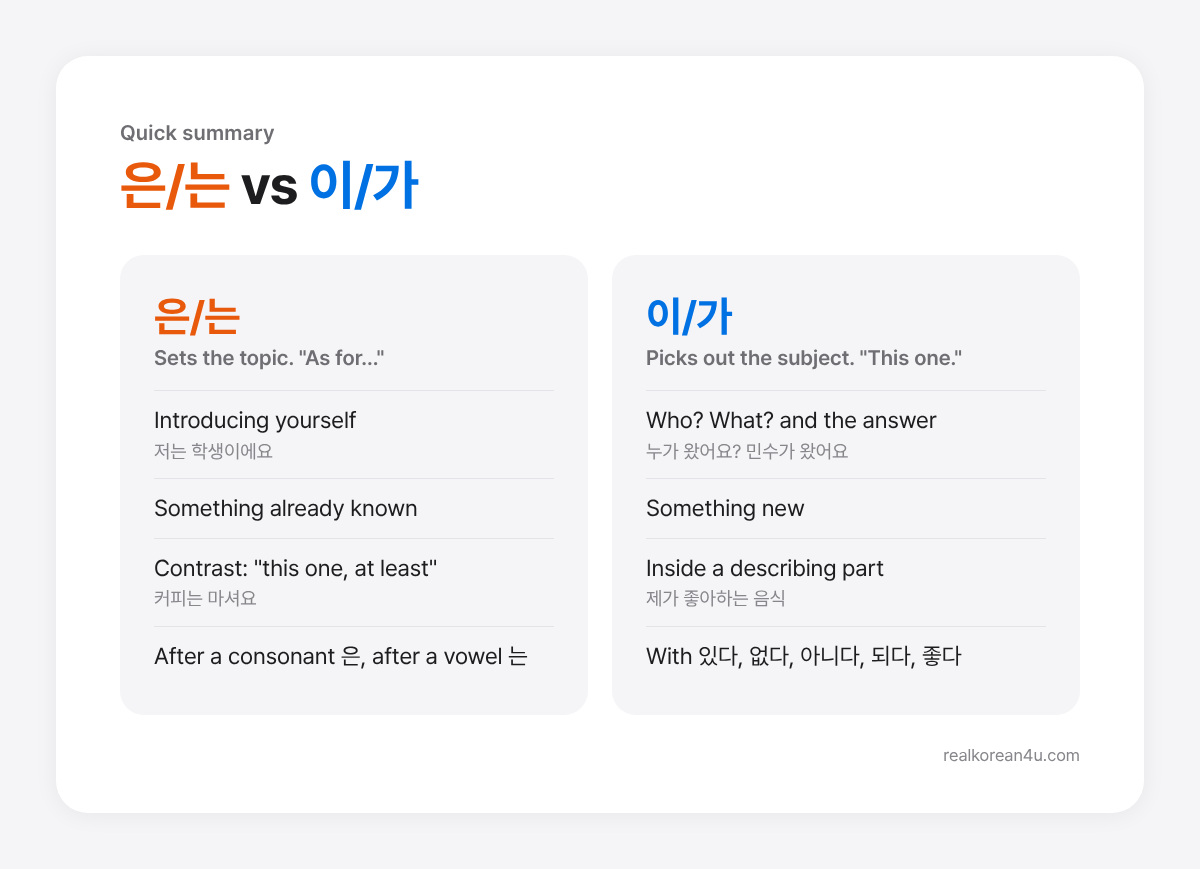
| 은/는 | 이/가 | |
|---|---|---|
| Basic job | Sets the topic | Picks out the subject |
| Introducing yourself | ✅ 저는… | ❌ |
| Who? What? and the answer | ❌ | ✅ 누가, 뭐가 |
| New vs known | Already known | New, just appeared |
| Inside a describing part | ❌ | ✅ 제가 좋아하는… |
| Extra meaning | Contrast (“this one, at least”) | Focus (“this one, not another”) |
✏️ Quick Quiz
Choose the natural particle. Try it before you check the answers.
- 안녕하세요. 저(는 / 가) 에밀리예요.
- A: 누가 이 케이크를 만들었어요? B: 제 동생(은 / 이) 만들었어요.
- 오늘은 돈(은 / 이) 없어요.
- 제(가 / 는) 자주 가는 카페는 학교 앞에 있어요.
👉 Show answers
- 는. “Hello, I’m Emily.” Self-introductions use 은/는. (In a formal first meeting, many Koreans would drop 저는 and say 에밀리입니다.)
- 이. “My younger sibling made it.” It answers 누가, so it takes 이/가.
- 이. “I don’t have money today.” 없다 takes 이/가. (오늘은 is the topic.)
- 가. “The café I often go to is in front of the school.” The describing part takes 이/가.
📗 Next: Learn the hidden “but” in 은/는 and how Koreans use it to sound polite. Contrast 은/는 in Korean: The Hidden “But” Native Speakers Hear