
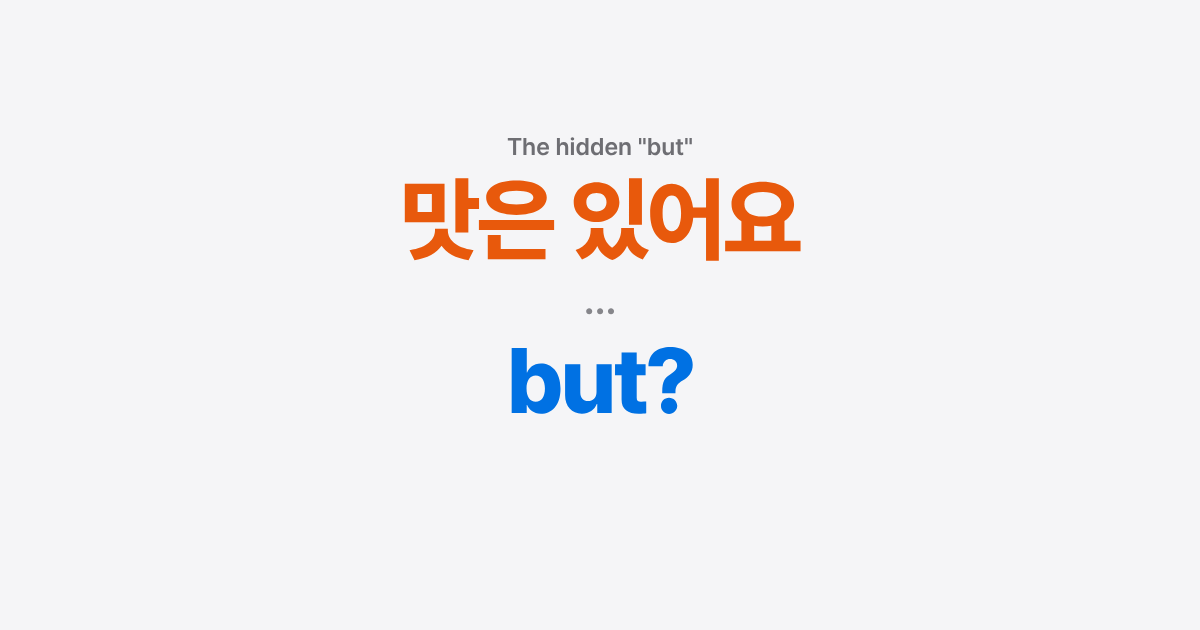
When Koreans put 은/는 on a word in the middle of a sentence, they often mean “this one, at least.” Native listeners hear an unspoken “but…” after it. Koreans use this hidden contrast to hint, to soften criticism, and to say no without saying no.
Level: Intermediate · TOPIK 3-4
Imagine a friend cooked for you and you ask how it was. They answer with three words.
It was tasty… (but)
Every Korean listener waits for the rest. Was it too salty? Too expensive? Not enough? The sentence is grammatically complete, but it does not feel finished. That feeling comes from one particle: 은.
What Contrast 은/는 Really Does
Compare two answers to “How was the restaurant?”
The food was good.
The food was good. (The service or the price, not so much.)
With 이, the speaker simply reports a fact. With 은, the speaker picks out the food from everything else about the restaurant. Once one thing is picked out, the listener naturally wonders about the rest.
Contrast 은/는 = “As for this, it’s true.”
The listener hears: “…but I’m not saying the same about other things.”
This is why 은/는 is less neutral than it looks. At the start of a sentence, as a simple topic, the contrast is weak. On objects, time words, and negatives, it becomes very noticeable.
Where the Hidden “But” Shows Up
1. On objects
Objects normally take 을/를. When 을/를 is replaced by 은/는, the speaker is limiting what they say to that one thing.
I can handle spicy food. (Other things might be a problem.)
Korean dramas, I watch sometimes. (Not much else on TV.)
2. On time words
오늘, 이번 주, 주말 with 은/는 suggest that other times are different. Koreans use this a lot when making or changing plans.
Today I’m free. (Other days, maybe not.)
On weekends, I usually get up late. (Unlike weekdays.)
3. Inside negatives: -지는 않다
Adding 는 to -지 않다 turns a clear “no” into a careful “not exactly.” It is one of the most common ways to give a lukewarm opinion.
I don’t dislike it. (But I’m not excited about it.)
It wasn’t hard, exactly. (But it wasn’t easy either.)
4. Stacked on other particles
은/는 can follow other particles: 에서는, 에게는, 까지는. The meaning stays the same: “in this case, at least.”
At work, I use polite speech. (Not with friends.)
I understood up to this point. (After that, I’m lost.)
How Natives Use It to Be Polite
![이/가 states a fact; contrast 은/는 adds an unspoken but]](https://realkorean4u.com/wp-content/uploads/2026/10/post02B_02_hidden-but.png)
Because the “but” is never said, contrast 은/는 lets speakers be honest without sounding harsh. The listener understands the message, and nobody has to say anything negative directly.
1. Giving honest feedback
A 어제 간 식당 어땠어요?
(How was the restaurant you went to yesterday?)
B 분위기는 좋았어요.
(The atmosphere was nice.)
B never criticizes the food. But A now knows the food probably wasn’t great.
2. Turning down a plan
A 이번 주 토요일에 등산 갈래요?
(Do you want to go hiking this Saturday?)
B 이번 주 토요일은 좀 어려울 것 같아요. 다음 주는 괜찮아요.
(This Saturday might be hard. Next week works.)
The 은 on 이번 주 토요일 says “this date is the problem, not you or the plan.” Adding 다음 주는 makes the contrast clear and keeps the invitation alive.
3. Giving a lukewarm opinion
A 그 영화 재밌었어?
(Was the movie fun?)
B 나쁘지는 않았어.
(It wasn’t bad.)
This is close to neutral, like “It was okay.” It is not a real compliment, but it is not a complaint either. B might even watch something similar again. If B really didn’t like it, a Korean would say 다시 볼 것 같지는 않아 (“I don’t think I’d watch it again”), which uses the same -지는 pattern.
When the Contrast Sends the Wrong Message
1. Answering a simple yes-or-no question
If someone asks 김치 좋아해요? and you answer 김치는 좋아해요, it sounds like “Kimchi, yes. Other Korean food, not really.” If you just mean yes, say 네, 좋아해요.
2. Complimenting food someone made
At a dinner table, 찌개는 맛있네요 is very rude. It sounds like “The stew is good. (Everything else isn’t.)” Drop the particle, or use 도 (“too”) to praise one dish without putting down the rest.
찌개는 맛있네요.
찌개 진짜 맛있네요!
찌개도 맛있어요.
찌개가 진짜 맛있네요 is also natural. The 가 just puts a little extra focus on the stew.
3. Repeating 저는 in every sentence
Once you are the topic, Koreans drop 저는. Starting every sentence with 저는 can sound like you keep comparing yourself with others: “I, unlike other people…” Use it once, then let the topic carry over.
🗣️ Try It Today
Pick one and use it with a Korean friend today.
오늘은 제가 살게요.
Today, it’s on me. (You paid last time.)술은 잘 못 마셔요.
I’m not much of a drinker. (A polite way to decline.)생각보다 어렵지는 않네요.
It’s not as hard as I thought.이번 주는 좀 바빠요.
This week is a bit busy for me.아직은 괜찮아요.
I’m OK for now.
Quick Quiz
✏️ What is the speaker hinting?
- 가격은 괜찮았어요. (about a hotel)
- A: 내일 만날래요? B: 내일은 안 돼요.
- A: 그 사람 어때? B: 나쁜 사람은 아니야.
- Which is polite to say to a host? (찌개는 / 찌개도) 맛있어요.
👉 Show answers
- The price was fine, but something else (the room, the location) was not.
- Tomorrow doesn’t work, but another day might. B is open to meeting.
- “He’s not a bad person…” A “but” is coming: maybe he’s boring or not my type.
- 찌개도. “The stew is good too.” 찌개는 sounds like the other dishes were bad, which is very rude.
Summary
Contrast 은/는 picks out one thing and quietly sets it apart from the rest. On objects, time words, and negatives like -지는 않다, Koreans hear an unspoken “but.” Use it to soften feedback and turn down plans politely. Avoid it when you simply mean yes or want to give a full compliment.
📘 Start with the basics 은/는 vs 이/가: The Difference Explained in 4 Simple Rules New to these particles? Learn the four rules that decide most sentences. Read the basics →