
너 means “you,” but Koreans only say it to close friends who are the same age or younger. With anyone else, it sounds rude. Most of the time, Koreans don’t say “you” at all. They use the person’s name, a title, or nothing.
Level: Beginner · TOPIK 1-2
In English, “you” works for everyone: your best friend, your boss, a stranger on the street. Korean has several words for “you,” and none of them is safe for everyone. This post shows which ones to avoid and what Koreans say instead.
The Short Answer: Why 너 Can Sound Rude
너 is casual. It belongs with 반말 (casual speech), so you only use it with close friends your age or younger.
For everyone else, Koreans skip “you” or replace it with a name or a title.
Here is the same question, asked to two different people.
너 뭐 먹을래?
neo mwo meogeullae?
What do you want to eat? (To a close friend your age.)
뭐 드실래요?
mwo deusillaeyo?
What would you like to eat? (To someone older, or someone you just met.)
The polite version has no word for “you” at all. The polite verb ending already shows who you are talking to.
| Part | Meaning |
|---|---|
| 뭐 | what |
| 드시다 | to eat (polite form of 먹다) |
| -(으)ㄹ래요? | do you want to…? |
Korean Words for “You” at a Glance
Textbooks list several words for “you.” In real conversation, most of them are risky.
| Word | Who uses it | Safe for learners? |
|---|---|---|
| 너 | Close friends, same age or younger | Only with close friends |
| 당신 | Married couples (like “honey”), arguments, ads and songs | ❌ Avoid |
| 그쪽 | Literally “that side.” Said to someone’s face, it sounds like picking a fight | ❌ Avoid |
| 자기 | Couples (“honey”) | ❌ Only with a partner |
| Name or title | Everyone | ✅ The safe choice |
너, 너가, 니가: Who Can You Say It To?
너 changes shape with particles. With 가 it officially becomes 네가, but in everyday speech most people say 너가. (We covered how 가 changes words like this in 은/는 vs 이/가.)
| Form | When Koreans use it |
|---|---|
| 너, 너는, 너가 | Friends who are the same age or younger |
| 니가 | Very close friends, younger siblings, sometimes couples |
| 네가 | The standard spelling. Common in writing |
Age matters more than closeness. Even with a friend you like a lot, if they are one year older, 너 usually sounds disrespectful.
너는 주말에 뭐 해?
neoneun jumare mwo hae?
What are you doing this weekend? (To a friend your age.)
선생님, 너는 주말에 뭐 해요?
The second sentence mixes a polite title with a casual “you.” It sounds strange and rude at the same time.
Why 당신 Is Not a Polite “You”
Many textbooks translate 당신 as the polite “you.” In conversation, it is almost never used that way. Said to a stranger, it can sound like you are starting a fight.
당신은 어디에서 왔어요?
어디에서 오셨어요?
eodieseo osyeosseoyo?
Where are you from?
You will still see 당신 in a few places. Married couples sometimes call each other 당신, but there it means something closer to “honey” or “darling,” not a polite “you.” It also appears in advertising slogans and song lyrics, where it sounds warm. In everyday conversation, leave it out.
What Koreans Say Instead
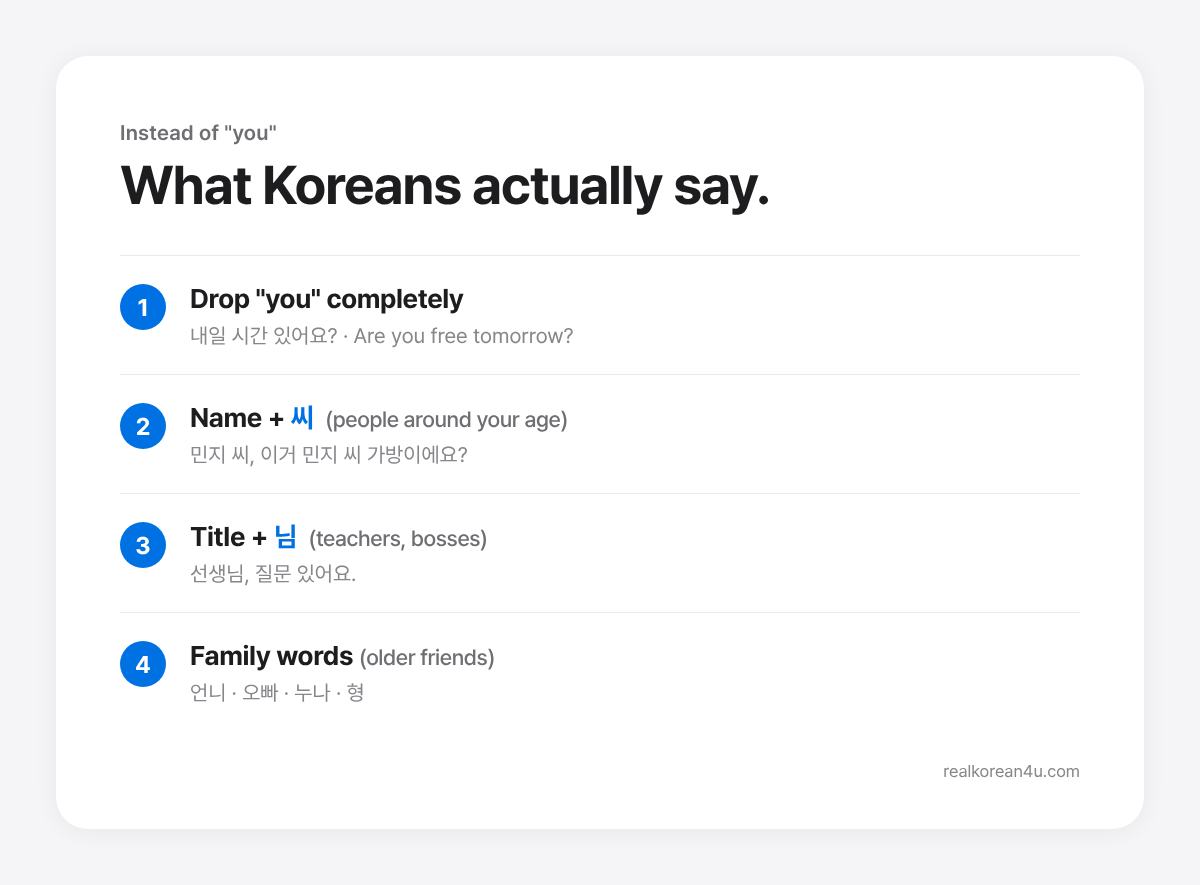
1. Drop “you” completely
This is the most common choice. If it is clear who you are talking to, Koreans leave the subject out.
naeil sigan isseoyo?
Are you free tomorrow?
2. Use the name + 씨
For coworkers or acquaintances around your age, use their given name and 씨. The full name + 씨 sounds cold between people who know each other.
minji ssi, igeo minjissi gabangieyo?
Minji, is this your bag?
Notice that Koreans repeat the name where English would say “your.” It sounds natural in Korean, not repetitive.
What about the family name + 씨, like 김 씨? You will rarely hear it in the city. It belongs to places like farming and fishing villages, where neighbors greet each other this way: 김 씨, 오늘 밭에 가요? (gim ssi, oneul bate gayo?, “Mr. Kim, heading to the field today?”). Close friends sometimes use it as a joking nickname. Otherwise, don’t use it.
3. Use a title
For teachers, bosses, and people older than you, use their title instead of “you.” Titles usually end in 님, which adds respect.
seonsaengnim, jilmun isseoyo.
Teacher, I have a question.
4. Use family words, even for friends
Koreans call older friends by words that mean “older sister” or “older brother.” A woman might say this to an older female friend:
eonni, igeo meogeo bwayo!
Try this! (To an older female friend.)
Common Mistakes
| ❌ Wrong | ✅ Right | Why |
|---|---|---|
| (To an older coworker) 너도 커피 마실래? | 커피 드실래요? keopi deusillaeyo? Would you like some coffee? |
너 and 반말 are for people your age or younger. |
| (To a shop clerk) 당신 이거 얼마예요? | 이거 얼마예요? igeo eolmayeyo? How much is this? |
당신 sounds confrontational. Just drop it. |
| (To a coworker you just met) 언니, 회의 언제예요? | 민지 씨, 회의 언제예요? minji ssi, hoei eonjeyeyo? Minji, when is the meeting? |
Family words are for friends. Using them too soon also suggests the person looks older. |
🗣️ Try It Today
Pick one and use it with a Korean friend today.
성함이 어떻게 되세요?
seonghami eotteoke doeseyo?
May I ask your name? (Very polite.)식사하셨어요?
siksahasyeosseoyo?
Have you eaten? (A common greeting.)저희 동갑이에요?
jeohi donggabieyo?
Are we the same age? (저희 is the polite “we.”)혹시 시간 괜찮으세요?
hoksi sigan gwaenchaneuseyo?
Do you have a moment, by any chance?호칭은 어떻게 하는 게 좋을까요?
hochingeun eotteoke haneun ge joeulkkayo?
How should I address you? (Very polite.)
Summary and Quick Quiz

| Talking to… | What to say |
|---|---|
| A close friend, same age or younger | 너 is fine |
| Someone older, or someone you just met | Drop “you” and use polite verb endings |
| A coworker around your age | Name + 씨 (민지씨) |
| A teacher or boss | Title + 님 (선생님, 팀장님) |
| An older friend | 언니, 오빠, 누나, 형 |
| Anyone in conversation | Avoid 당신 |
✏️ Quick Quiz
Is it OK to use 너 (or 당신) here? Try it before you check the answers.
- Talking to your best friend, who is your age: 너 내일 바빠?
- Talking to your friend’s mom: 당신은 커피 좋아하세요?
- Talking to a coworker who is three years older: 너 점심 먹었어?
- Asking a stranger for directions: 그쪽은 역이 어디인지 알아요?
👉 Show answers
- OK. A close friend your age is exactly who 너 is for.
- Not OK. 당신 sounds rude here. Say 커피 좋아하세요? or call her 어머니 (mother).
- Not OK. They are older, so drop 너 and be polite: 점심 드셨어요?
- Not OK. 그쪽 sounds like you want to pick a fight, even a little sarcastic. Start with 저기요 (excuse me): 저기요, 역이 어디예요?
📗 Next: Learn exactly who to call 언니, 오빠, 선배, 씨, or 님, and which ones can backfire. What to Call People in Korean: 씨, 님, 선배, 언니 and 오빠