
Korean has two common ways to say “because”: -아/어서 and -(으)니까. Most textbooks translate both as “because” or “so,” which makes them look the same.
Level: Beginner · TOPIK 1-2
They are not the same. In some sentences only one of them is correct. In others, both are correct but sound different. This post covers both cases.
The Short Answer: -아/어서 vs -(으)니까
-아/어서 states a cause as a simple fact.
-(으)니까 gives a reason the speaker is using to make a point, ask for something, or suggest something.
Here is the same idea with each ending.
biga waseo jibe isseosseoyo.
It rained, so I stayed home.
biga onikka usaneul gajyeogaseyo.
It’s raining, so take an umbrella.
Let’s break down these two sentences.
| Part | Meaning |
|---|---|
| 비 | rain |
| 가 | subject marker |
| 오다 → 와서 | to come + -아/어서 (because) |
| 집에 있었어요 | stayed at home |
| Part | Meaning |
|---|---|
| 오다 → 오니까 | to come + -(으)니까 (because) |
| 우산을 | umbrella + object marker |
| 가져가세요 | please take (it with you) |
In Korean, rain “comes” (비가 오다). The first sentence just reports what happened. The second uses the rain as a reason to tell someone what to do.
How to Form Them
| Verb / adjective | -아/어서 | -(으)니까 |
|---|---|---|
| 가다 (to go) | 가서 gaseo | 가니까 ganikka |
| 오다 (to come) | 와서 waseo | 오니까 onikka |
| 먹다 (to eat) | 먹어서 meogeoseo | 먹으니까 meogeunikka |
| 공부하다 (to study) | 공부해서 gongbuhaeseo | 공부하니까 gongbuhanikka |
| 덥다 (to be hot) | 더워서 deowoseo | 더우니까 deounikka |
- -아서: when the last vowel of the stem is ㅏ or ㅗ
- -어서: all other vowels
- 해서: verbs ending in 하다
- -으니까: when the stem ends in a consonant
- -니까: when the stem ends in a vowel
Verbs like 덥다 change their form before both endings. These are called ㅂ-irregular verbs.
Three Rules That Decide for You
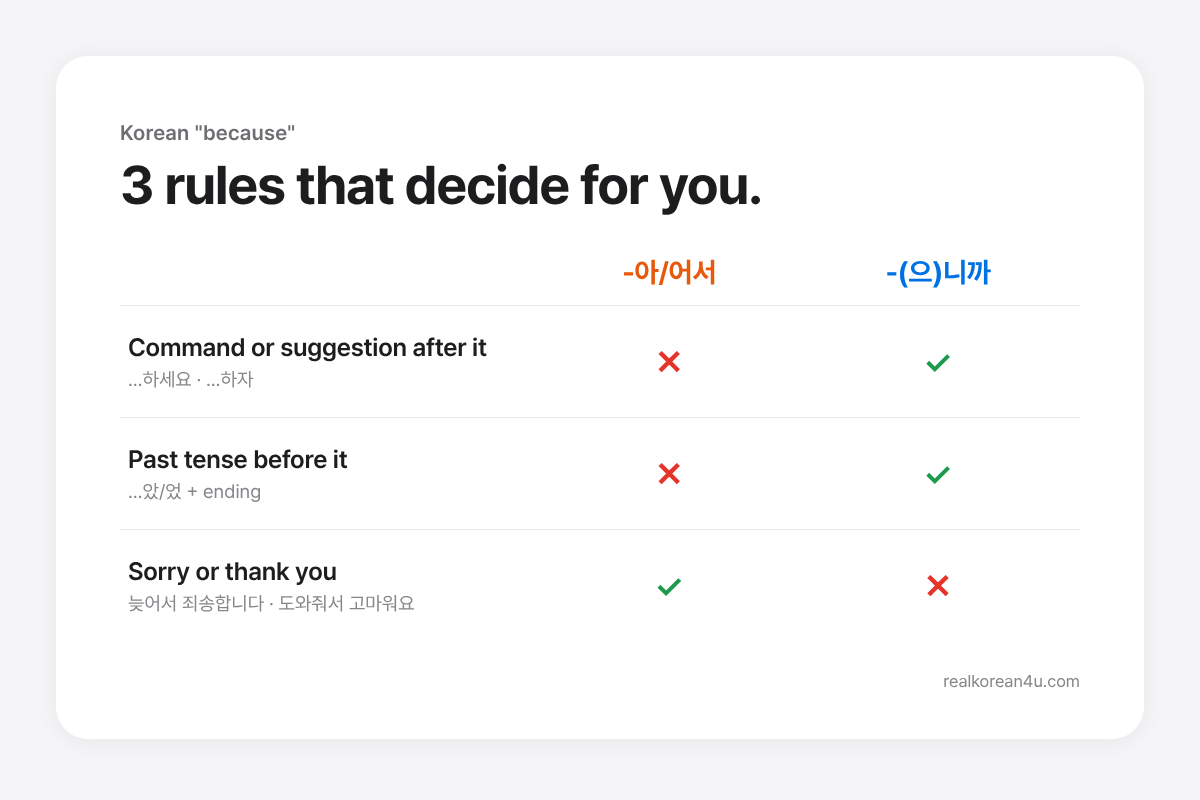
Before thinking about nuance, check these three rules. They cover most of the cases where only one ending is correct.
Rule 1: Commands and suggestions need -(으)니까
If the second half of the sentence tells someone to do something (-(으)세요) or says “let’s” (-자), use -(으)니까. -아/어서 does not work here.
시간이 없으니까 빨리 가자.
sigani eopseunikka ppalli gaja.
We don’t have time, so let’s hurry.
시간이 없어서 빨리 가자.
길이 막히니까 지하철을 타세요.
giri makinikka jihacheoreul taseyo.
The roads are jammed, so take the subway.
길이 막혀서 지하철을 타세요.
Native tip: “Shall we…?” questions
When Koreans suggest something with -(으)ㄹ까요? (“Shall we…?”), they usually give the reason with -는데, not -(으)니까.
비도 오는데 택시 타고 갈까요?
bido oneunde taeksi tago galkkayo?
It’s raining, so shall we take a taxi?
날씨도 좋은데 산책할까요?
nalssido joeunde sanchaekhalkkayo?
The weather’s nice, so shall we go for a walk?
비가 오니까 택시 타고 갈까요? is grammatically correct, but it sounds stiff. Notice the 도 (“also”) in these sentences. It makes the suggestion sound softer and more natural.
Rule 2: -아/어서 cannot take the past tense
With -아/어서, the tense goes at the end of the sentence, not before the ending. -(으)니까 can take the past tense directly.
어제 많이 걸어서 다리가 아파요.
eoje mani georeoseo dariga apayo.
I walked a lot yesterday, so my legs hurt.
어제 많이 걸었어서 다리가 아파요.
어제 많이 걸었으니까 오늘은 쉬세요.
eoje mani georeosseunikka oneureun swiseyo.
You walked a lot yesterday, so rest today.
Rule 3: Apologies and thanks use -아/어서
When you say sorry or thank you, use -아/어서. With -(으)니까, the reason sounds like an excuse or an argument.
늦어서 죄송합니다.
neujeoseo joesonghamnida.
I’m sorry for being late.
도와줘서 고마워요.
dowajwoseo gomawoyo.
Thank you for helping me.
늦었으니까 죄송합니다.
The same goes for greetings like 만나서 반가워요 (mannaseo bangawoyo, “Nice to meet you”).
When You’re Just Explaining
When you simply explain why something happened, -아/어서 is the natural choice. -(으)니까 can sound a little off in the same sentence.
바빠서 못 가요.
bappaseo mot gayo.
I can’t go because I’m busy.
바쁘니까 못 가요.
Grammatically possible, but it sounds unfinished to native ears.
Koreans who want to use -(으)니까 here usually end the sentence with -죠 instead.
bappeunikka mot gajyo.
I’m busy, so of course I can’t go.
This version is natural, but it has an attitude. It sounds like “Isn’t it obvious?” and can come across as annoyed or even rude. When you turn down an invitation politely, use -아/어서.
Native Speaker’s Note
In everyday conversation, Koreans often end a sentence with -(으)니까요, like 바쁘니까요 (“Because I’m busy”). It works as a short answer to “Why?”
The tone depends on how you say it. Said softly, it is a normal explanation. Said firmly, it can sound like “Obviously, because I’m busy.” In casual speech, you will also hear it pronounced as -니깐.
Two Look-Alike Meanings
Both endings have a second meaning that has nothing to do with “because.” Learners often mix these up.
-아/어서: “and then”
With movement verbs like 가다 and 만나다, -아/어서 can link two actions in order.
chingureul mannaseo yeonghwareul bwasseoyo.
I met my friend and (then) we watched a movie.
Meeting the friend is not the reason for the movie. It is the first step.
-(으)니까: “when I did …, I found …”
When the second half is something you discovered, -(으)니까 means “when I did this, I found that.”
bakke naganikka nuni ogo isseosseoyo.
When I went outside, (I found that) it was snowing.
Going outside did not cause the snow. It is how the speaker noticed it.
Summary and Quick Quiz
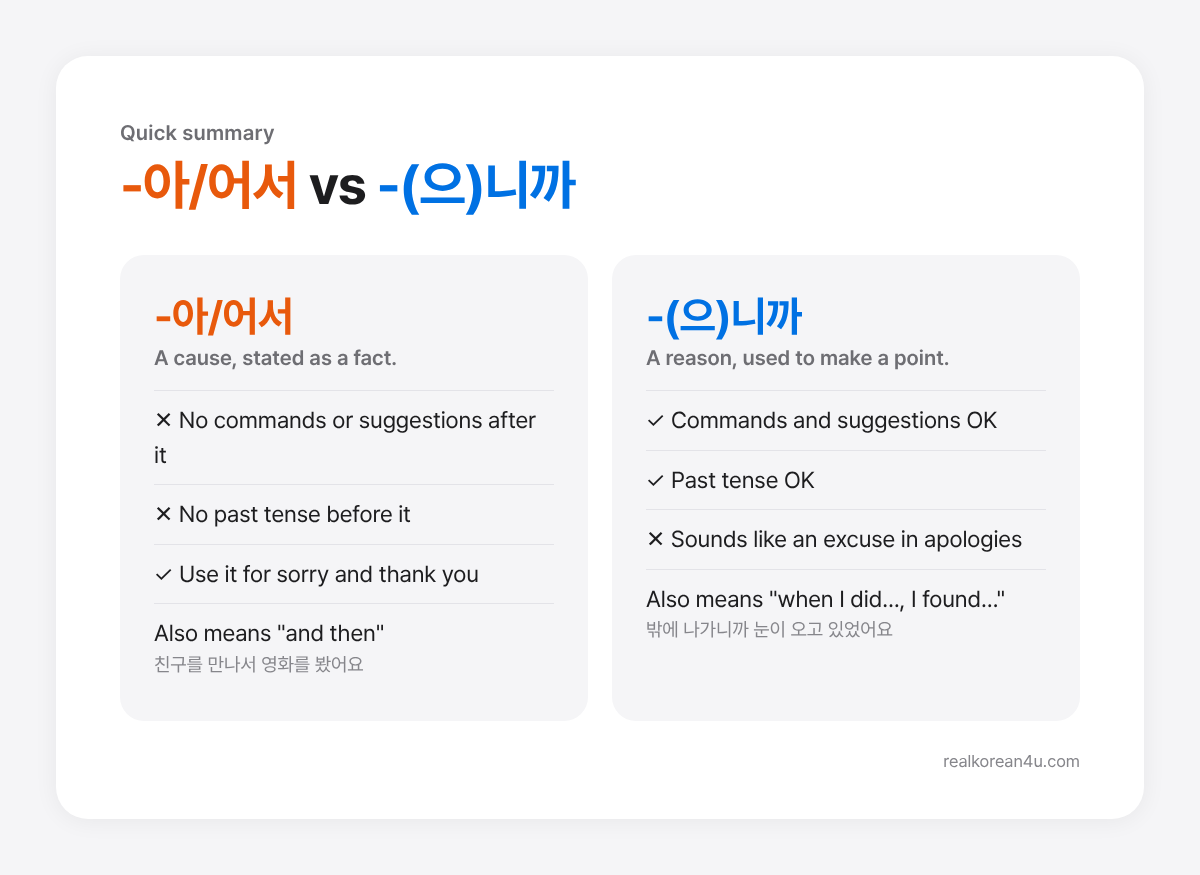
| -아/어서 | -(으)니까 | |
|---|---|---|
| Basic meaning | Cause as a fact | Reason to make a point |
| Command / suggestion after it | ❌ | ✅ |
| Past tense before it | ❌ | ✅ |
| Sorry / thank you | ✅ | ❌ |
| Second meaning | “and then” | “when I did …, I found …” |
Common mistakes
| ❌ Wrong | ✅ Right | Why |
|---|---|---|
| 비가 와서 우산을 가져가세요. | 비가 오니까 우산을 가져가세요. biga onikka usaneul gajyeogaseyo. |
The sentence ends with a request. |
| 잠을 못 잤어서 피곤해요. | 잠을 못 자서 피곤해요. jameul mot jaseo pigonhaeyo. I couldn’t sleep, so I’m tired. |
No past tense before -아/어서. |
| 와 줬으니까 고마워요. | 와 줘서 고마워요. wa jwoseo gomawoyo. Thank you for coming. |
Thanks use -아/어서. |
What about -기 때문에?
-기 때문에 is a third way to say “because.” It sounds more formal and is common in writing and speeches. Like -아/어서, it is not used before commands or suggestions. We will cover it in a separate post.
✏️ Quick Quiz
Choose the correct ending. Try it before you check the answers.
- (추워서 / 추우니까) 창문을 닫아 주세요.
- 선물을 (줘서 / 주니까) 고마워요.
- 어제 (아팠어서 / 아팠으니까) 오늘은 집에서 쉬세요.
👉 Show answers
- 추우니까. “It’s cold, so please close the window.” The sentence ends with a request.
- 줘서. “Thank you for the gift.” Thanks use -아/어서.
- 아팠으니까. “You were sick yesterday, so rest at home today.” It has the past tense and ends with a command.