
Some Korean phrases look perfectly polite but can still sound rude: 수고하세요 to your boss, 몇 살이세요? to an older person, 당신, a flat “알았어요,” and over-polite praise like 대단하시네요. Here is why each one can backfire and what Koreans say instead.
Level: Beginner · TOPIK 1-2
Korean politeness is not only about adding -요 or -시-. Who you are talking to, what the words literally mean, and your tone all matter. Ironically, very polite language can even sound sarcastic. These five phrases are where learners get caught most often.
1. 수고하세요 to Someone Above You
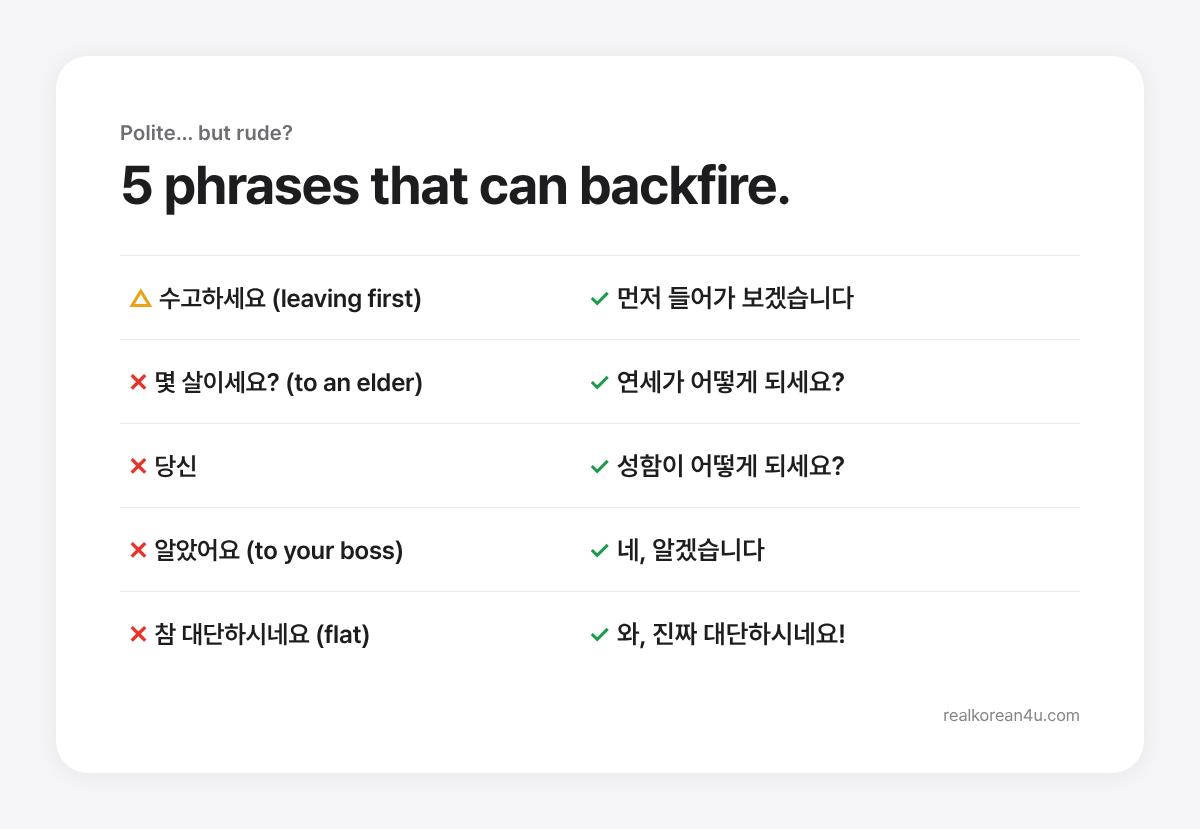
수고하세요 literally means “Keep up the hard work.” People say it when leaving a shop or the office. Traditionally, it can sound like you are praising someone’s effort from above, so some people think it is not right to say it to a boss or an older person.
- △ (Leaving the office before your boss) 수고하세요.
- ✅ 먼저 들어가 보겠습니다.
meonjeo deureoga bogetseumnida.
I’ll be heading out first.
In practice, it’s about tone, not the sentence. Said politely with a bow, 수고하세요 is usually fine even with seniors, unless the relationship is very formal. With a store clerk or someone your age, it is common and friendly. But if you have to pick one when leaving before your boss, 먼저 들어가 보겠습니다 sounds more polite.
2. 몇 살이세요? to an Older Person
Adding -세요 makes 몇 살이에요? look polite, but 살 is a plain word for age. With someone clearly older, Koreans use a more respectful question. In fact, many Koreans avoid asking an older person’s age at all unless there is a good reason.
| Asking… | Say |
|---|---|
| A child or a younger friend | 몇 살이야? / 몇 살이에요? |
| Someone around your age you just met | 나이가 어떻게 되세요? |
| Someone much older, like a friend’s grandparent | 연세가 어떻게 되세요? |
실례지만, 나이가 어떻게 되세요?
sillyejiman, naiga eotteoke doeseyo?
If you don’t mind me asking, how old are you?
3. 당신 as a Polite “You”
Many textbooks list 당신 as the polite “you.” In conversation, it often sounds like the start of an argument. Between married couples it means something close to “honey,” but with anyone else, leave it out. (More in How to Say “You” in Korean.)
당신은 이름이 뭐예요?
성함이 어떻게 되세요?
seonghami eotteoke doeseyo?
May I ask your name?
4. A Flat 알았어요 to Your Boss
How you say “Got it” depends on who you are talking to. With a friend your age, say 알았어. With a very close friend, many people just say 오키 (Okie). 알았어요 is polite in form, and it is fine with friends you speak politely to. To a boss or a teacher who just gave you a task, a flat 알았어요 can sound curt, like “Yeah, yeah, I got it.” In that situation, Koreans say 알겠습니다. It is more formal, and the -겠- makes it sound like you are ready to take care of it, not just that you heard the request.
(Your boss asks you to send a file) 알았어요.
네, 알겠습니다.
ne, algetseumnida.
Yes, I’ll do that.
5. Over-Polite Praise: 대단하시네요
Here is one of the strange things about Korean: very polite language can sound sarcastic. When someone says something negative while using extra-polite forms like -시네요, it stings more. 대단하시네요 can be real praise, or it can mean “Wow, unbelievable.”
wa, jinjja daedanhasineyo!
Wow, that’s really amazing! (Bright tone, real praise.)
cham daedanhasineyo.
Well, aren’t you something. (Flat tone, after someone did something annoying.)
To keep praise sincere, add 와 or 진짜 and say what was good. (More in When -네요 Sounds Sarcastic.)
Why These Mistakes Happen
All five look correct in a grammar book. The problem is never the ending. It is one of three things:
| Reason | Example |
|---|---|
| The literal meaning sounds like an order or judgment | 수고하세요 |
| The word itself is too plain for the person | 몇 살, 당신 |
| The tone or situation changes the meaning | 알았어요, 대단하시네요 |
So when you learn a polite phrase, also learn who it is for. That is the part textbooks often leave out.
The last reason is worth remembering on its own. In Korean, extra-polite forms are not automatically safer. If your words or tone don’t match the situation, the extra politeness can make the sentence sound colder, or even sarcastic. Natural, warm politeness always beats stiff, over-the-top politeness.
🗣️ Try It Today
Pick one and use it with a Korean friend today.
먼저 들어가 보겠습니다.
meonjeo deureoga bogetseumnida.
I’ll head out first. (Leaving work.)네, 알겠습니다.
ne, algetseumnida.
Yes, understood.실례지만, 나이가 어떻게 되세요?
sillyejiman, naiga eotteoke doeseyo?
If you don’t mind me asking, how old are you?오늘 정말 감사했습니다.
oneul jeongmal gamsahaetseumnida.
Thank you so much for today.조심히 들어가세요.
josimhi deureogaseyo.
Get home safely.
Quick Quiz
✏️ What would you say instead?
- You leave the office before your manager. (수고하세요 / 먼저 들어가 보겠습니다)
- You ask your friend’s grandmother her age. (몇 살이세요? / 연세가 어떻게 되세요?)
- Your teacher gives you homework. (알았어요 / 네, 알겠습니다)
- You meet someone new. (당신은 이름이 뭐예요? / 성함이 어떻게 되세요?)
👉 Show answers
- 먼저 들어가 보겠습니다. Both can be fine in a polite tone, but this one sounds more polite.
- 연세가 어떻게 되세요? 연세 is the respectful word for age.
- 네, 알겠습니다. A flat 알았어요 can sound curt.
- 성함이 어떻게 되세요? 당신 can sound confrontational.
Summary
Polite endings are not enough on their own. When leaving before your boss, 먼저 들어가 보겠습니다 is the safer choice. Use 나이 or 연세 instead of 몇 살 for adults, skip 당신, answer bosses with 알겠습니다, and keep extra-polite praise warm and specific so it never sounds sarcastic.
📘 Start with the basics 10 Common Mistakes Korean Learners Make (and How to Fix Them) The everyday mistakes beginners make, with the natural way to say each one. Read the basics →