

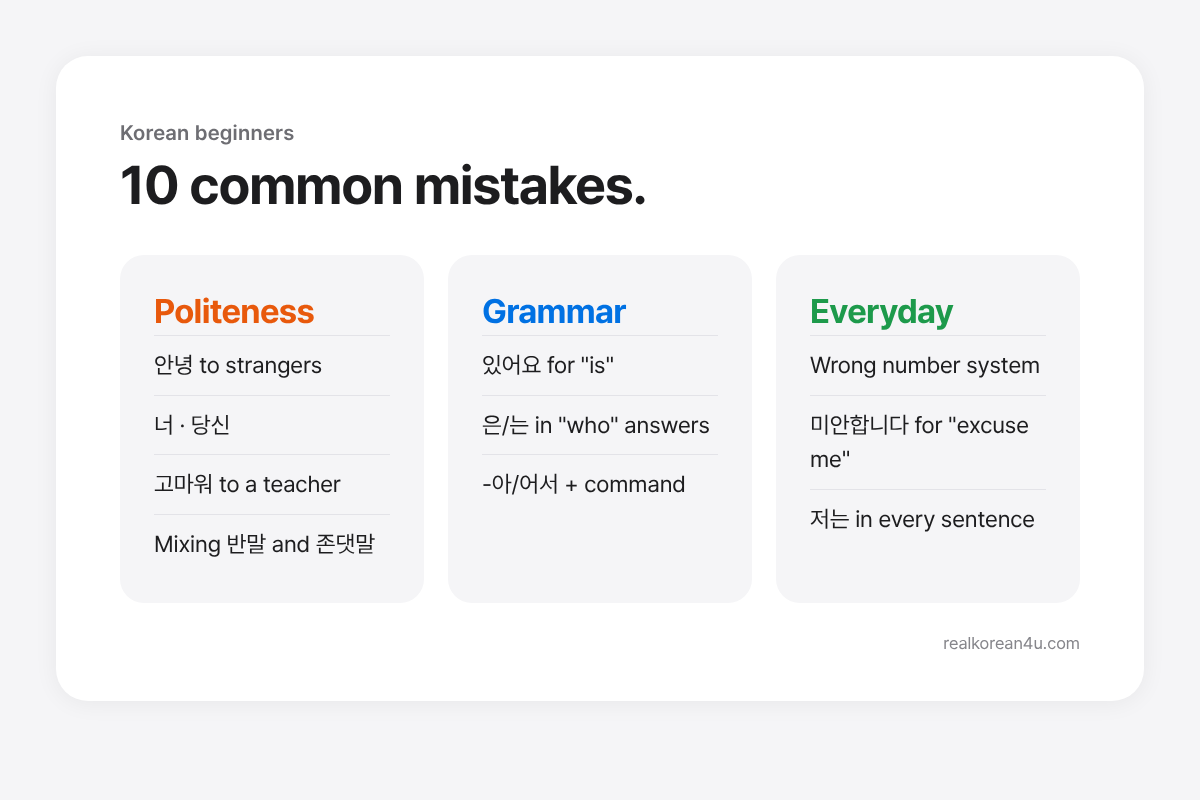
The most common Korean mistakes are not about hard grammar. They are small things: using 너 with the wrong person, mixing casual and polite speech, picking the wrong number system, or answering a question with the wrong particle. Here are 10 mistakes beginners make, with the natural way to say each one.
Level: Beginner · TOPIK 1-2
Koreans will usually understand you even with these mistakes. But they notice them right away, and a few of them can sound rude without you meaning it. Fix these ten, and your Korean will sound much more natural.
The Short Answer: The 10 Mistakes
Politeness: 안녕 to strangers, 너 and 당신, 고마워 to a teacher, mixing 반말 and 존댓말.
Grammar: 있어요 instead of 이에요, the wrong particle in answers, -아/어서 before a command.
Everyday words: the wrong number system, 미안합니다 for “excuse me,” and saying “I” in every sentence.
Politeness Mistakes
1. Saying 안녕 to a stranger
안녕 is casual. Use it with friends and children. For everyone else, say 안녕하세요.
(To a shop clerk) 안녕.
안녕하세요.
annyeonghaseyo.
Hello.
2. Calling people 너 or 당신
너 is only for close friends your age or younger, and 당신 is not a polite “you” in conversation. Most of the time, just drop “you.” (We explain this in detail in How to Say “You” in Korean.)
(To someone you just met) 당신은 학생이에요?
학생이세요?
haksaengiseyo?
Are you a student?
3. Saying 고마워 to a teacher
고마워 is casual “thanks.” With teachers, bosses, and anyone older, use 감사합니다 or 고맙습니다.
(To your teacher) 고마워.
감사합니다.
gamsahamnida.
Thank you.
4. Mixing 반말 and 존댓말
Learners often start politely and then slip into casual endings, or the other way around. Pick one speech level for each person and stay with it.
(To your boss) 네, 알았어.
네, 알겠습니다.
ne, algetseumnida.
Yes, understood.
Even fully polite phrases can backfire, though. Some sentences look perfect on paper and still sound rude to Koreans.
🗣️ Native insight Why can a polite phrase like 수고하세요 sound rude to your boss? 5 polite-looking Korean phrases that can backfire, and what to say instead. Read the answer →Grammar Mistakes
5. Using 있어요 instead of 이에요/예요
이에요/예요 means “is” (A is B). 있어요 means “there is” or “I have.” Many learners mix them up because English uses “is” for both.
저는 학생 있어요.
저는 학생이에요.
jeoneun haksaengieyo.
I’m a student.
6. Answering a “who” question with 은/는
When someone asks 누가 (who) or 뭐가 (what), the answer takes 이/가. (See 은/는 vs 이/가.)
A: 누가 왔어요? B: 제 친구는 왔어요.
제 친구가 왔어요.
je chinguga wasseoyo.
My friend came.
7. Using -아/어서 before a command
When the sentence ends with “please do” or “let’s,” the reason takes -(으)니까, not -아/어서. (See -아/어서 vs -(으)니까.)
추워서 문 닫아 주세요.
추우니까 문 닫아 주세요.
chuunikka mun dada juseyo.
It’s cold, so please close the door.
Everyday Word Mistakes
8. Using the wrong number system
Korean has two sets of numbers. Native Korean numbers (하나, 둘, 셋) are for counting things and hours. Sino-Korean numbers (일, 이, 삼) are for minutes, money, dates, and phone numbers. Time uses both at once.
삼 시 삼십 분이에요.
세 시 삼십 분이에요.
se si samsip bunieyo.
It’s 3:30.
| Use | Number system | Example |
|---|---|---|
| Hours, ages, counting things | Native Korean | 세 시, 스무 살, 사과 두 개 |
| Minutes, money, dates | Sino-Korean | 삼십 분, 만 원, 시월 십일 |
Korean numbers are a big topic, so we will cover them step by step in a separate series: counting things, telling time, money, dates, and more.
9. Saying 미안합니다 for “excuse me”
In English, “Excuse me” and “I’m sorry” overlap. In Korean, 미안합니다 is an apology. To get someone’s attention, use 저기요. To pass through a crowd, use 잠시만요.
(Calling a waiter) 미안합니다.
저기요.
jeogiyo.
Excuse me.
(Squeezing past people on the subway) 잠시만요.
jamsimanyo.
Excuse me, coming through.
10. Saying “I” in every sentence
English needs a subject in every sentence. Korean doesn’t. Once it’s clear you are talking about yourself, drop 저는. Repeating it in every sentence sounds stiff, and it can even sound like you are comparing yourself with others.
저는 커피를 좋아해요. 저는 매일 마셔요. 저는 라테를 좋아해요.
저는 커피를 좋아해요. 매일 마셔요. 특히 라테를 좋아해요.
jeoneun keopireul joahaeyo. maeil masyeoyo. teuki rateureul joahaeyo.
I like coffee. I drink it every day. I especially like lattes.
Don’t Let Mistakes Stop You
Most Koreans are happy when a foreigner tries to speak Korean, and they rarely mind small grammar slips. The mistakes that matter most are the politeness ones, because they can change how people feel about you. Grammar and number mistakes just make you sound like a learner, which you are.
If you are not sure whether something sounded right, it’s completely fine to ask. Koreans are usually glad to explain.
jega matge malhaennayo?
Did I say that right?
jega matge malhan ge mannayo?
Is what I said correct?
🗣️ Try It Today
Pick one and use it with a Korean friend today.
잠시만요~
jamsimanyo~
Excuse me, coming through. (Say it softly, with a gentle tone.)여기요, 주문할게요.
yeogiyo, jumunhalkkeyo.
Excuse me, I’d like to order. (If the server is already looking at you, just 주문할게요 is fine.)지금 몇 시예요?
jigeum myeot siyeyo?
What time is it now?잘 먹겠습니다.
jal meokgetseumnida.
Thank you for the meal. (Before eating.)다시 한번 말해 주세요.
dasi hanbeon malhae juseyo.
Could you say that again, please?
Summary and Quick Quiz
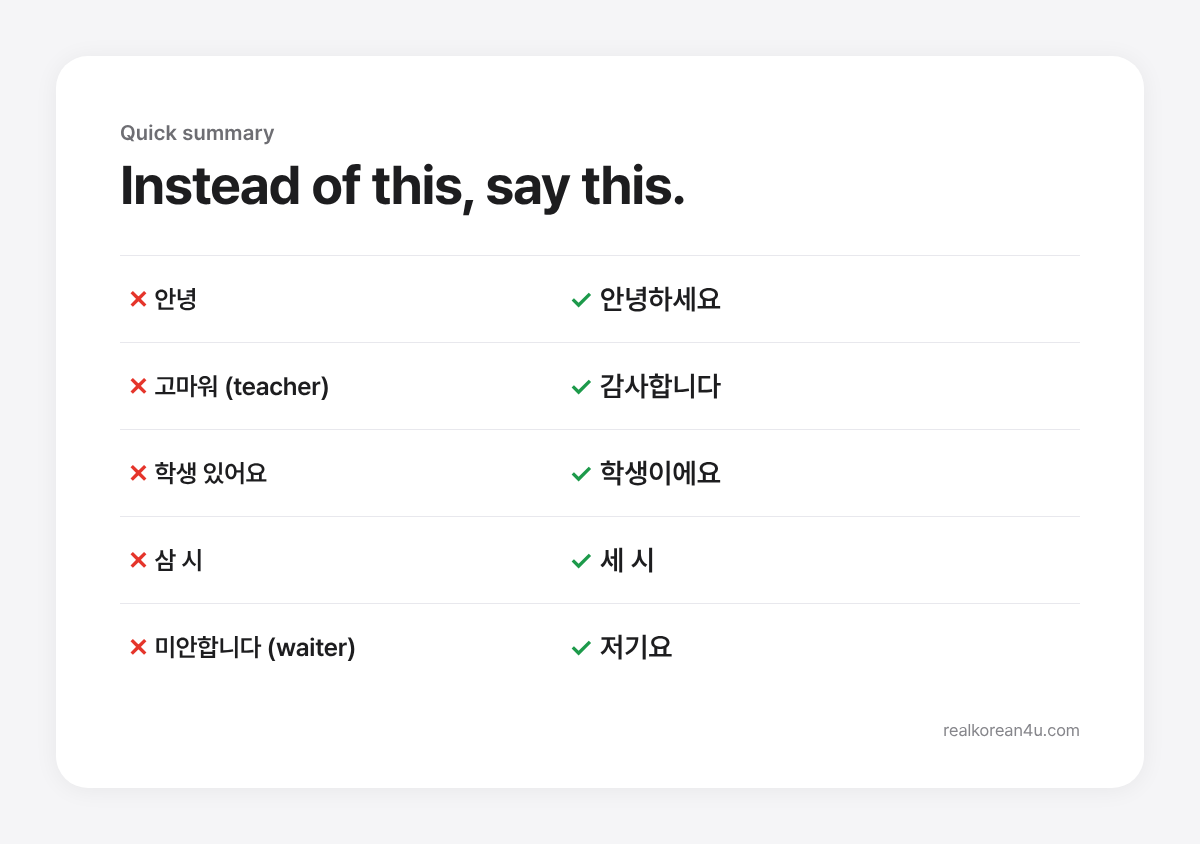
| ❌ Instead of | ✅ Say |
|---|---|
| 안녕 (to strangers) | 안녕하세요 |
| 너, 당신 | Drop “you,” or use a name or title |
| 고마워 (to a teacher) | 감사합니다 |
| 학생 있어요 | 학생이에요 |
| 삼 시 | 세 시 |
| 미안합니다 (to a waiter) | 저기요 |
✏️ Quick Quiz
Find and fix the mistake. Try it before you check the answers.
- (To your teacher) 선생님, 고마워.
- 지금 두 시 두 분이에요.
- (Calling a waiter) 미안합니다, 물 좀 주세요.
- 저는 회사원 있어요.
👉 Show answers
- 선생님, 감사합니다. 고마워 is casual.
- 두 시 이 분이에요. Minutes use Sino-Korean numbers.
- 저기요, 물 좀 주세요. 미안합니다 is an apology.
- 저는 회사원이에요. “A is B” uses 이에요/예요.
📗 Next: Some phrases look perfectly polite and still sound rude. Learn the five most common ones. 5 Polite-Looking Korean Phrases That Can Sound Rude